


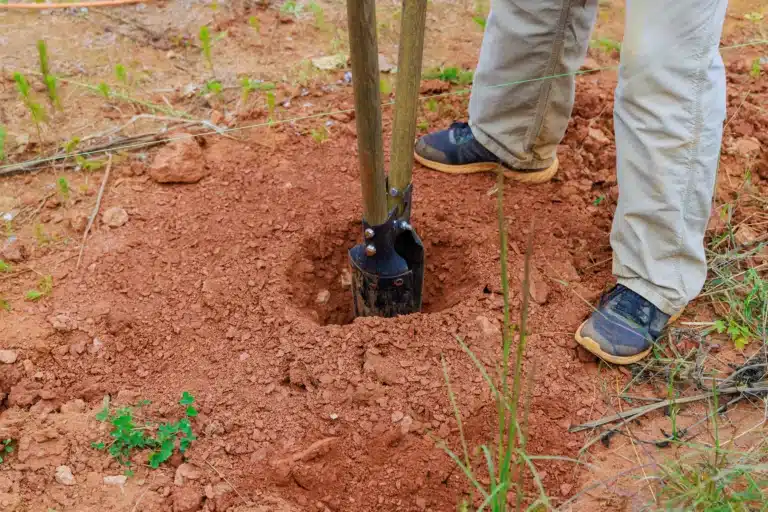
Set about a third of the post's total length below grade: for a standard 6 foot privacy fence that means a hole 30 to 36 inches deep, dug about three times the width of the post. How deep should fence posts be on your own lot? Three things decide it: the frost depth your locality publishes, whether you are digging Piedmont clay or Coastal Plain sand, and how much load that particular post has to carry.
What depth to plan on
- Bury about one third of the post's total length, and never less than 24 inches.
- Dig the hole about three times the width of the post, so roughly 10 to 12 inches for a 4×4.
- Gate, corner and end posts go about 6 to 12 inches deeper than the line posts beside them, in a wider hole.
- Finish the bottom of the hole below the frost depth your locality publishes.
- Call 811 and wait for the utility locate before anyone digs the first hole.
How deep should fence posts be for a 6 foot fence?
Two rules do most of the work. The first is the one third rule printed on the concrete bag: bury a third of the post, dig the hole about three times the post's width, and never go shallower than 24 inches. The second is the published fencing specification, which asks for 24 inches plus 3 inches for every foot of fence height above 4 feet, so 30 inches under a 6 foot fence.
University extension guidance for farm fencing sets the floor in the same place: wooden line posts should be set at least 2 feet deep, preferably deeper. Below two feet, a post is relying on the top layer of soil, which is the layer that moves.
How deep fence posts should be by fence height
Here is what the two rules work out to by fence height, using 4×4 wood line posts:
| Fence height | Post length | Line post depth | Gate, corner and end posts | Hole width |
|---|---|---|---|---|
| 3 to 4 ft picket | 6 ft | 24 in | 30 in | 10 to 12 in |
| 5 ft | 8 ft | 27 to 30 in | 33 to 36 in | 10 to 12 in |
| 6 ft privacy | 8 to 9 ft | 30 to 36 in | 36 to 42 in | 12 in |
| 8 ft privacy | 12 ft | 36 to 48 in | 48 in | 12 to 14 in |
The 6 foot row is the one worth reading twice. A standard 8 foot post set only 24 inches down leaves a quarter of the post in the ground, not a third. That holds in firm, well drained soil on a sheltered lot. On an open lot that catches wind, on a slope, or in soft ground, a 9 foot post set 36 inches deep is the stronger answer, and it costs a few dollars a post rather than a rebuild.
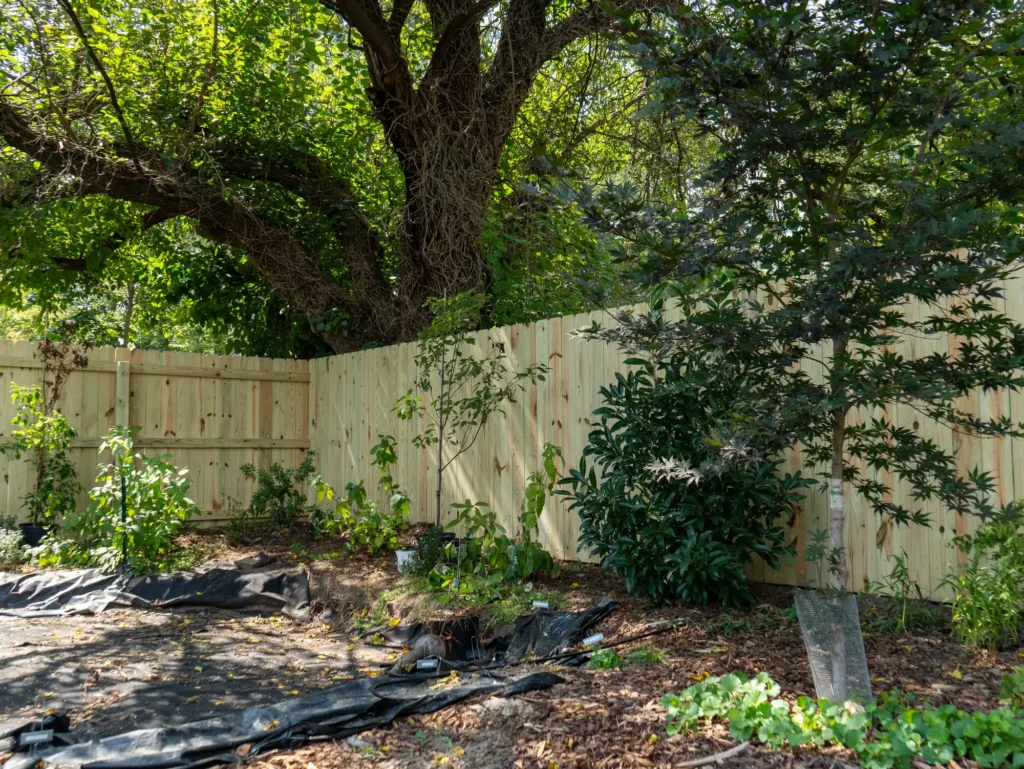
A 6 foot pressure treated wood privacy fence behind a planted garden bed and a mature shade tree in Richmond.
How deep gate, corner and end fence posts go
Every published specification treats these as a different post. The federal fencing standard sets line posts driven 24 inches, while corner, gate, end and pull posts are set 36 inches where possible. Agency fence specifications do the same thing at a smaller scale: one state sets line posts at 24 inches and brace and gate posts at 3 feet, another sets 30 and 36. Residential installation guidance lands in the same place, putting gate and corner posts 6 to 8 inches deeper than the line posts, in concrete, in a hole at least 12 inches across.
So the working number is 6 inches deeper for a corner or an end post, and 6 to 12 inches deeper for a gate post. A gate swings its whole weight against one post several times a day, and a wide drive gate doubles that argument: give it the extra depth, the wider hole and, where the span is long, a heavier post than the line run uses.
Does the frost line change how deep you dig in Virginia?
Yes, and it is the number most online depth advice gets wrong, because people write much of that advice for climates nothing like Virginia's. Each locality sets its own frost depth; there is no national number. Virginia localities publish theirs in the climatic and geographic design criteria the residential code uses, so the number that matters is your county's, and your building department will give it to you over the phone.
Once you have it, the rule is simple. Where ground freezes, the footing should sit below the local frost line even when the one third rule would stop higher, and you follow whichever number is deeper.
A residential fence is not a house footing, and a fence rarely needs a permit for its footings alone. The physics does not care. Water trapped in the soil above the frost line freezes, expands and lifts whatever it has hold of, so a post whose concrete stops short gets jacked a little higher every cold snap. Over a few winters that reads as a wavy top rail and a gate that stops latching in January.
So treat the local frost depth as a floor and the one third rule as the target. Where the published depth is shallower than 30 inches, the one third rule is the deeper of the two and sets the number on a 6 foot fence. Where it is deeper, the frost depth wins, so check it before you buy posts.
What does Virginia red clay or coastal sand do to a post hole?
Soil decides how a hole behaves once you dig it. Central Virginia sits on Piedmont red clay, which holds water against a post instead of letting it drain away. That is how a post rots at the groundline years before the pickets give out.
East of the fall line the ground runs sandier, and sand grips a post far less willingly than clay does. Sandy soil needs a deeper hole than clay for the same stiffness, so a yard down toward Williamsburg often needs more depth, a wider footing, or both to get what a Midlothian clay lot gives for free.
Three habits that work in either soil
- Match the base to the soil. Crushed stone under the post drains well in light, sandy ground, but research cited in the installation literature warns that in clay the same gravel can trap a pool of water around the base of the post.
- Dig straight sided holes, not a cone that is wide at the top. A cone shaped plug of concrete is exactly the shape frost needs to lift it out.
- Finish the collar so water runs off. Crown the concrete and slope it away from the post rather than leaving a dish that holds rain against the wood.
Fill dirt is the quiet problem in new subdivisions. Around a recently built home the first two feet are often material that was pushed there, not soil that settled over centuries, and a post set only into fill is set into nothing. That is a case for digging past the fill until the auger hits undisturbed ground.
How does a crew decide how deep fence posts go on your property?
A crew decides depth at the fence line, not in the office. A crew walks the run, reads the grade and the soil coming out of the first hole, and sizes the rest of the job from there.
Before you start
Call 811 before anyone digs a post hole, and wait for the utility locate to be marked. Gas, power and communication lines can sit well within post hole depth, and finding one with an auger turns a fence job into an emergency.
How a post hole gets sized
- Mark the fence line, call 811, and wait for the locate.
- Look up your locality's frost depth and treat it as the minimum for the bottom of the hole.
- Pick the post length from the fence height so about a third of it ends up underground.
- Dig the first hole and read what comes out: red clay, sand, gravel or builder's fill.
- Dig the rest straight sided, about three times the post width, adding depth at gates, corners and ends.
- Set the base, plumb the post, then crown the backfill so water runs away from the wood.
Terrain changes the math
On the steep wooded slope in Henrico where we ran a 4 foot black aluminum fence down a ravine lot, every post took a different share of the grade. On a planted Richmond city garden we built a 6 foot pine privacy fence around mature beds without disturbing a single one, which decides where a hole can go before it decides how deep it is. Every one of our wood fences is stick built on site for the same reason: the yard sets the depth, and the depth is not set before we see the yard. Whether that hole gets concrete, gravel or tamped soil is its own question, covered in do fence posts need concrete.
Have us dig the first hole
Good Neighbor Fence has been family owned since 2006 and builds across Richmond, Fredericksburg and Williamsburg. On-site quotes are free, and the visit is where depth gets settled: your soil, your grade, your fence height, your gates.
How deep should fence posts be? Questions people ask
How deep should a 6 foot fence post be in the ground?
Plan on 30 to 36 inches for line posts, using an 8 or 9 foot post. The published fencing specification gives 30 inches at that height, and the one third rule gives 36 on a 9 foot post, so anything in that band is defensible in Richmond area soil.
How deep should a 4 foot fence post be?
About 24 inches, using a 6 foot post. That follows the one third rule and matches the 24 inch minimum both the concrete makers and the farm fencing guidance use.
How much deeper should a gate post be than a line post?
About 6 to 12 inches deeper, in a hole at least 12 inches across, set in concrete. Corner and end posts carry the pull of a whole run and earn the same treatment.
Do fence posts have to go below the frost line in Virginia?
No code makes a residential fence meet footing rules the way a house does, but the bottom of the hole should still sit below the frost depth your locality publishes. Shallow posts get lifted by freezing ground, and the fence shows it as an uneven top line.
How wide should a fence post hole be?
About three times the width of the post, so roughly 10 to 12 inches for a 4×4. A wider hole gives the concrete collar more soil to bear against, which matters most in sandy ground.
Keep reading