



Yes, you can install a fence in winter in Virginia. Crews work right through the season, and in most years the ground around Richmond and Northern Virginia never freezes deep enough to stop a post hole. Winter fence installation is harder to picture than it is to build, and because the phone rings less in December and January, booking now usually means an earlier start date than waiting for spring.
What winter really changes
- Each Virginia locality sets its own frost depth: about 18 inches around Richmond, 24 inches in Northern Virginia.
- Crews dig fence post holes below the frost line anyway, so a cold snap changes the first few inches of the dig.
- Wet clay and heavy rain delay far more winter jobs than cold does.
- Lawns and beds are dormant, so there is less planting to work around and less to repair in spring.
- Quotes are free and on-site, and most installs still run one to two days.
Does the ground freeze too hard to dig in Virginia?
Almost never, and almost never for long. The frost line is the depth to which ground water in soil is expected to freeze, and foundations are built below it so freeze and thaw cannot lift them (Frost line, Wikipedia). Our guide to how deep fence posts should be covers local frost depths in more detail.
Virginia adopts the International Residential Code and leaves that number to each city and county: roughly 18 inches in Richmond and the Piedmont, 12 to 18 inches in Tidewater, and 24 inches in Northern Virginia, the Shenandoah Valley and the mountains (Frost Line Depth in Virginia).
Read those numbers the way a builder does. However, they describe the worst the ground could do, not what a crew finds on a normal January morning in Henrico or Loudoun. After a cold night you get a crust on exposed soil, and an auger goes through it.
A fence post hole has to reach below that frost line regardless of the season, so winter does not change the depth of the work. It changes the first few inches of it.
Never backfill with frozen soil
Frozen clumps look solid going into the hole, then thaw and shrink, which leaves voids around the post and a fence that leans by March. The hole bottom should sit on firm, unfrozen soil, and the backfill should go in loose and unfrozen.
What actually stops a winter fence install here
Water, not temperature. Central Virginia clay holds rain for days, and a saturated yard is the real reason a January job moves on the calendar. Driving equipment across soft ground tears up turf and leaves ruts a homeowner looks at all summer.
These are the conditions that move a winter date:
- Days of steady rain, with standing water or mud in the fence line
- Snow cover deep enough to hide the layout and the grade
- Ice on slopes, where footing matters more than digging
- A hard, prolonged freeze, which is short lived in this part of Virginia
None of those cancel a project. They shift it by a few days, and a winter calendar has room to shift. A spring calendar does not.
Does cold weather change how you install fence posts in winter?
It changes the care, not the method. Concrete footings are the part of a cold-weather install worth asking about, so ask any contractor what they do differently once temperatures sit near freezing. For what goes in the hole, see do fence posts need concrete.
Materials behave in the cold too. Wood is stiffer, vinyl is less forgiving to handle, and gate hardware wants adjusting once everything settles. A crew that builds here year round plans for that. If you want to know what we use underground before the cold arrives, our wood fence installation page walks through how we build.
Is winter a good time to install a fence in Virginia?
For most homeowners in our area, it is the easiest time to get one. Three reasons:
You get a date instead of a queue. Quote requests pile up from March, and the people who called in December are already on the schedule. Every fence we install is stick-built on site, so your date is crew time, not a panel delivery.
Your yard is dormant. Grass is not growing, beds are cut back, and the damage a crew can do to a landscape in July is mostly not there to do in January.
The fence is up before you want it. Pool season, puppies, spring parties and new sod all come at once. As a result, if we finish your fence in February, it is done before any of that starts.
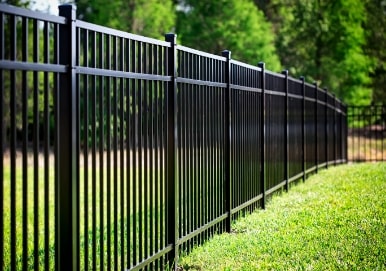
A black aluminum fence closing in a freshly graded Midlothian backyard that is waiting on new lawn, the kind of job that goes in best before the grass does.
Get your winter fence install on the schedule
Tell us what you want fenced and we will come out, walk the property and price it. Quotes are free and on-site, and our crew finishes most installations in one to two days once your date comes up.
See the work near you
Good Neighbor Fence has been family owned since 2006 and builds across Central and Northern Virginia. You can see what that looks like locally on our Richmond fence company page, or in a job like this 6 foot pine privacy fence around a planted Richmond city garden, which we built without disturbing a single bed.
Winter fence install questions people ask
Can you dig fence post holes in frozen ground?
Yes, in Virginia conditions. A freeze here usually hardens the top few inches of exposed soil, and the hole still has to go below the local frost depth of roughly 18 to 24 inches, so the frozen layer is a small part of the dig.
What is the best time of year to install a fence in Virginia?
Whichever season you can get a crew. Spring is the most requested and the slowest to book, late fall and winter are the quietest, and the quality of the finished fence does not depend on the month.
Does snow or rain delay fence installation?
Rain does more often than snow. Saturated clay risks rutting a lawn, so we would rather move your date a few days than drive equipment across a soaked yard.
How long does a winter fence installation take?
Most full installations are finished in one to two days, the same as any other season. Weather can add a day between the dig and the build if a storm lands in the middle of the job.
Keep reading