



How long does a wood fence last? In Central Virginia, plan on roughly 15 to 20 years from a well-built pressure-treated pine fence. Expect the posts to outlast the boards when they carry a ground-contact rating. A wood fence lasts as long as its posts stay solid. The posts almost always fail before the pickets do.
That makes this a practical question, not an academic one. If the posts are sound, a tired fence is a repair job. If the posts are going, new pickets only buy a season.
What decides the number
- Rot starts at the ground line, where wood gets water and air together. Posts fail there first, while boards that dry out between rains last for years.
- Posts set in the ground need lumber rated for ground contact. The American Wood Protection Association calls for Use Category 4A or higher for posts in the soil.
- Properly pressure-treated posts are long-lived: extension forestry figures put them at 20 to 35 years, with an average of about 30.
- Cedar earns its reputation above ground. A maintained cedar fence runs about 15 to 20 years, and it still wants treated posts in the holes.
- Untreated or dip-treated posts are not a long-term material at all, whatever the fence costs to build.
What decides how long a wood fence will last?
Four things, in this order: what the posts are made of and how they are set, how well water drains away from them, the wood used above ground, and how often anyone touches the fence after it goes up.
Rot is a biological process with one bottleneck, and that bottleneck is water that stays. The University of Kentucky's extension forestry note on selecting fence posts explains that posts rot first at the ground line. That is where water and air combine best for decay. Boards that get rained on and dry out by the next afternoon are fine for years. Wood sitting in damp clay never dries.
Virginia gives rot a long season. Warm, wet summers suit decay fungi. Then winter freeze and thaw cycles work on the same fence from the other direction, opening checks in the boards and loosening fasteners. Our climate asks more of a fence than a dry climate does.
How long does a wood fence last by type of wood?
Here is the honest spread we see in Central Virginia yards. The ranges assume posts set properly with drainage, not a post dropped in a hole full of standing water.
Pressure-treated pine
The workhorse of Virginia privacy fencing, and what most of our wood fences are built from. Figure on 15 to 20 years from the fence as a whole. Ground-contact posts often stay sound when the boards and gates need replacing.
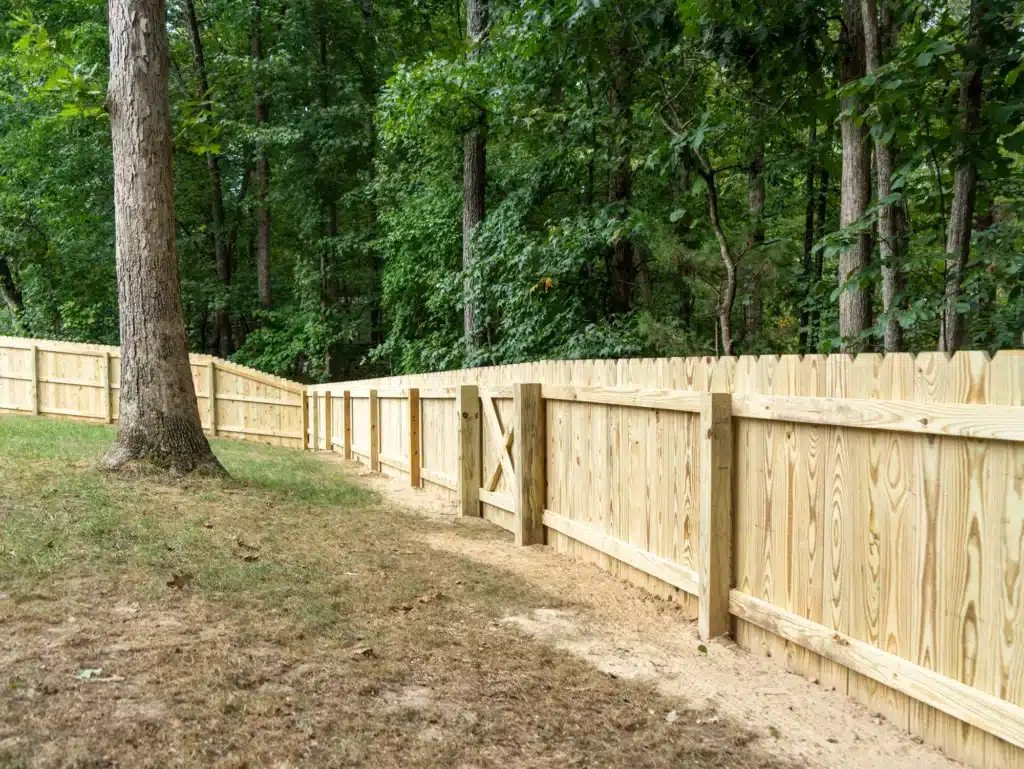
Pressure-treated pine privacy on a Short Pump lot. Pine on ground-contact posts is the Richmond-area workhorse.
Cedar boards on treated posts
Cedar heartwood resists decay on its own, which makes it a good board and rail choice. However, cedar is not the right pick for the buried part of a post. Most guides put a maintained cedar fence at 15 to 20 years. On pressure-treated posts, that is the number to plan around.
Untreated or builder-grade pine
Bargain pine put straight into the ground with no ground-contact rating is the shortest-lived fence we get called out to. Extension guidance treats untreated and dip-treated posts as unsuitable for long-term use. In Richmond clay, these fences start leaning inside five to ten years, and nobody can straighten them.
The upper end of those ranges is real, not marketing. The USDA Forest Products Laboratory has been running preservative stake tests since the 1930s, with treated southern pine specimens evaluated after exposure periods of 30, 35 and 55 years in the ground. Oregon State's extension guide to selecting and preserving fence posts gives pressure-treated posts an average service life of about 30 years. The posts are rarely what runs out first on a residential fence.
Cedar is the other side of that coin. Growers of western red cedar put a properly maintained cedar fence at 15 to 20 years on the strength of its natural resistance to decay and insects. That is good value above ground, but still no reason to bury an untreated post.
Why do fence posts rot at ground level first?
Look at a failed post and the damage is almost always in a band a few inches either side of the soil line. Below that the ground is wetter but colder and lower in oxygen. Above it, the wood dries. At grade you get water, air and warmth together, which is exactly what decay fungi want.
That is why the treatment rating on the tag matters more than anything else you buy. On our Richmond city garden job we used natural pressure-treated pine, because for posts set in the ground the American Wood Protection Association calls for Use Category 4A or higher, a heavier preservative retention than the lighter rating carried by pickets and rails. Same-looking lumber, very different service life in a hole.
Check the posts before you buy boards
Grab each post at shoulder height and push hard. If it rocks in the ground, or a screwdriver tip sinks into the wood at soil level, that post is done. Replacing pickets on failing posts spends money on a fence that will be leaning again by next summer. If it is sound but leaning, see how to fix a leaning fence.
Two details add years for very little money. A rot board along the bottom of the fence keeps pickets out of wet soil and mulch, and it is a cheap board to swap out later. The habits in our guide to fence post rot protection deal with the rest: drainage at the post, sprinkler heads aimed away, soil and mulch pulled back off the wood.
When should you replace a wood fence instead of repairing it?
Count posts, not pickets. Replacement usually wins in three cases. A third or more of the posts move when you push them, rails are pulling free along most of the run, or so many patches have gone in that the sections no longer line up. Our fence repair page covers how we make that call, and what a wood fence costs in Virginia covers the replacement side.
Repair usually wins when the posts are solid and the damage is cosmetic or local: a few split boards, one leaning section after a storm, a sagging gate. Our page on wood fence repair cost walks through what drives the price for pickets, rails and posts, which is the comparison worth making before you commit either way.
Why age alone is a poor trigger
A twenty-year-old fence on sound ground-contact posts can be worth re-boarding. In contrast, a ten-year-old fence on untreated posts is usually past saving. Judge the fence by what the posts do under your hand, not by the date on the invoice.
Not sure whether yours has years left?
We will walk the line with you, push every post and tell you straight whether this is a repair or a replacement. Free on-site quotes, and our crew finishes most installs in 1 to 2 days.
Local work backs this up. On a wood privacy fence for a Richmond city garden, we built a 6 foot pine privacy fence around a mature garden without disturbing a single bed, installing natural pressure-treated pine dog-ear privacy set tight against the established beds. If you are pricing a replacement for spring, our wood fence installation page shows the styles we build across Richmond, Mechanicsville, Chesterfield, Henrico, Glen Allen and Midlothian.
How to make a wood fence last longer
Keep water moving and keep wood off soil. Pull mulch and flower beds back from the boards, trim vines and shrubs that hold damp against the fence, and move any sprinkler that soaks a post twice a week.
Then keep the surface sealed on a schedule rather than when it looks grey. A finish slows the wetting and drying that opens checks and splits, and those splits are how water gets into end grain. Our guide on sealing a wood fence covers the timing and the finish.
Last, fix small things early. A loose rail, a gate dragging in the dirt or one cracked picket all put load or water somewhere the fence cannot carry it.
Wood fence questions: how long will yours last?
How often should you replace a wooden fence?
Replace it when the posts fail, not on a set schedule. Most owners here get 15 to 20 years out of a well-built pressure-treated fence, with a few picket and rail repairs along the way.
What is the best time of year to replace a fence in Virginia?
Autumn and winter are good times to plan and book. The ground is workable, yards are dormant so there is less planting to protect, and you are choosing a build date rather than waiting out the spring rush.
Can you replace just a few fence posts?
Yes, when the rest of the line is sound. Single post replacement is routine repair work, and it is worth doing early, because one failed post pulls on the sections either side of it.
What are the downsides of a wood fence?
It needs maintenance that vinyl and aluminum do not: sealing, the occasional board, and attention to anything holding moisture against the wood. In exchange, you get a fence you can repair piece by piece, matched to your grade with no gaps underneath.
Keep reading
Sources