


A 6 ft pressure-treated privacy fence runs about $25 to $50 per linear foot installed, so wood fence cost in Virginia usually works out to roughly $2,500 to $5,000 for a 100 ft side yard and $4,000 to $10,000 for a standard 200 ft back yard. Those are HomeGuide's national installed figures, and installed means the whole job: layout, post holes, concrete, posts, rails, boards, fasteners, on-site cutting and cleanup, not a pile of lumber sitting at the yard waiting for someone to build it.
Every yard prices differently, so use these wood fence cost numbers for Virginia to set a budget, and treat the on-site quote as the real answer.
Before you compare quotes
- A 6 ft pressure-treated privacy fence: about $25 to $50 per linear foot installed in national cost data.
- At that rate, 100 ft lands near $2,500 to $5,000, and a 200 ft back yard near $4,000 to $10,000.
- Installed means posts, concrete, rails, boards, hardware, cutting and cleanup, all of it.
- In addition, gates and demolition price on top: roughly $245 to $568 for a walk gate, and $3 to $10 a foot to tear out an old fence.
- The on-site quote is free, and most installs are finished in 1 to 2 days.
What does a wood fence cost per linear foot in Virginia?
In short, per foot is the only unit that lets you compare two quotes fairly. Take the total, divide it by the number of feet of fence, and you have a number you can hold next to anybody else's. After all, a 100 ft quote and a 240 ft quote tell you nothing side by side until you do that.
In fact, most of what you pay is labor and the things that hold the fence up. Fixr puts wood fence materials at $5 to $15 a foot and labor at $10 to $20, for an installed range of $15 to $35 a foot. Labor is the larger half on most jobs, which is why a material-only estimate from a big box calculator reads so much lower than a real quote.
However, national cost pages average the whole country, including markets where nobody digs through clay or rock. Overall, Central Virginia yards sit inside that band. Where your job lands in it comes down to the line itself: slope, soil, access, corners and gates. Above all, treat a quote far below the bottom of the range as a quote with something left out of it.
Wood fence cost in Virginia by style and height
Style changes the price because it changes how much board goes into a run and how long the run takes to build. Here is how the common wood styles line up, cheapest to dearest, for the same length of fence.
| Style | How it goes together | What it does to the price |
|---|---|---|
| Split rail | Posts with two or three rails, no boards | The least material and the fastest to set, so the lowest per foot |
| Spaced picket | Pickets with a gap between each one | Fewer boards than privacy, so it sits well below a solid fence |
| Stockade or dog ear | Boards set edge to edge on rails | The Richmond baseline for 6 ft privacy |
| Shadowbox | Boards alternate front and back of the rails | More board than stockade, and it looks finished from both sides |
| Board on board | Each board overlaps the one beside it | The most board in a privacy run, so the highest of the common styles |
| Horizontal | Boards run sideways between the posts | Closer post spacing and far more cutting, so labor climbs |
For a sense of the spread, HomeGuide prices a picket fence at $20 to $50 a linear foot installed and a privacy fence at $25 to $60. That gap, an open front yard fence against a solid back yard screen, is about what we see on a quote sheet here.
How height changes the number
Likewise, height moves the number as much as style does. A 4 ft picket is the cheapest fence we build around a front yard. A 6 ft privacy fence is the standard back yard order across Richmond, Midlothian, Glen Allen and Mechanicsville.
For example, going from 6 ft to 8 ft costs more than the extra two feet of board suggests. Taller posts have to go deeper to hold a taller sail, the holes get bigger, the concrete goes up, and most 8 ft runs want a third rail. HomeGuide's wood figures run up to $75 a linear foot at 8 ft, half again the top of the 6 ft range, so expect a real step in price.
Get a number for your own yard
First, we measure your lot, price the exact fence you want, and give you a written number before we leave. The visit costs nothing, and financing is available through Wisetack with rates starting at 0% APR if you would rather spread the payments.
What a real quote includes, and what it doesn't
A proper wood fence quote covers the whole job: walking and marking the line, digging post holes, concrete, posts, rails, boards, fasteners, cutting every board on site, hanging the gates and hauling the scrap away. Utility locating belongs in there too. No crew should put a bar in the ground before the underground lines are marked, so ask each bidder who files the locate request and how long it takes.
These items are usually priced separately, and they are where two quotes drift apart:
- Tearing out and hauling away an old fence: about $3 to $10 per linear foot, so $300 to $1,000 on a 100 ft line. Posts set in concrete sit at the top of that range.
- A standard walk gate: about $245 to $568 installed, averaging near $399.
- A double drive gate: about $483 to $1,007, averaging near $735.
- Stain or sealer, post caps, trim and a rot board along wet ground.
Also, permits are a local question rather than a statewide one, and the rules are stricter for a fence that doubles as a pool barrier than for a plain back yard screen. Call your city or county permit office before you sign anything, and check your HOA at the same time, because association approval often takes longer than the paperwork does. Ask at the on-site visit which submittals your locality and your association want, and get them moving early.
Six things that move wood fence cost in Virginia
For wood fence cost in Virginia, the length and the style set the starting number. The lot decides where inside the range you land, and these six things do most of the moving.
The ground your fence goes into
Slope. Ground that falls away is the single biggest swing. A stick-built fence follows the grade board by board, so the bottom stays tight to the ground. Panels have to step, and every step leaves a wedge of daylight for a dog to find.
Clay and rock. Central Virginia soil fights the auger. Heavy red clay, buried brick and rock mean slower holes and more spoil to carry out, and both show up as hours.
Access. If the only way into the back yard is a 32 inch gate or a wooded slope, every post, bag of concrete and bundle of boards goes in by hand.
Tree roots and beds. Established plantings along the line need the posts worked around them rather than through them.
The fence you ask us to build
Corners and gates. A straight run is the cheapest foot of fence you will ever buy. Corners, ends and gate posts each take extra bracing and extra time, so a chopped-up line costs more per foot than a long one.
Material grade. Pressure-treated pine is the workhorse of Virginia privacy fencing and sits at the lower end of the ranges above. HomeGuide puts a cedar privacy fence at $35 to $40 a linear foot installed, so on a 150 ft yard the species alone can move the total by a few thousand dollars. Whatever the species, anything in the ground has to be rated for ground contact, which is worth reading about before you compare lumber on price alone: see our note on pressure-treated wood for your fence.
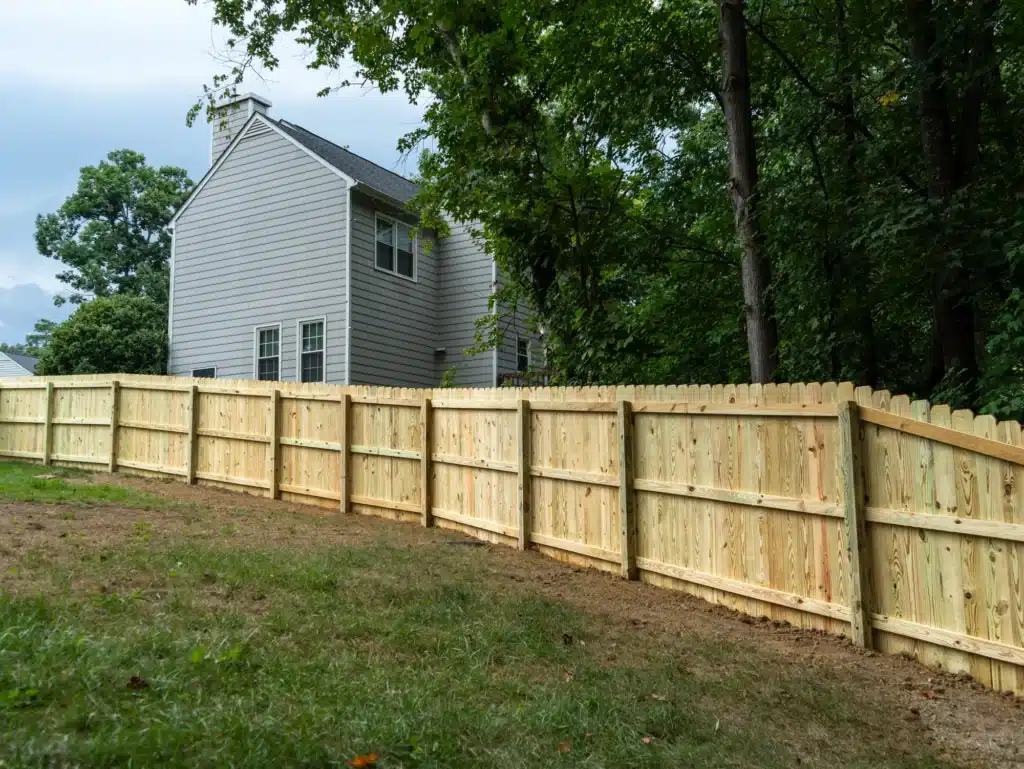
A stick-built privacy fence stepping down along a sloped Short Pump back yard.
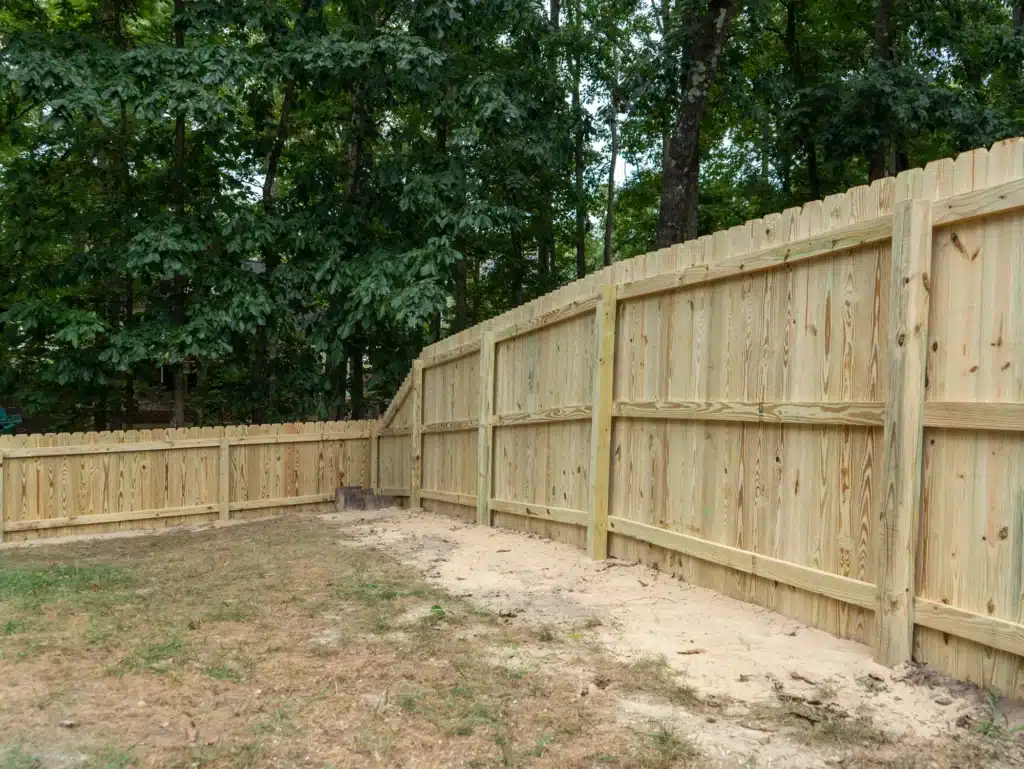
Stepped Dog-Ear Privacy Fence for a Short Pump Home
Pressure-treated pine standing a full 6 ft beside the house and along the side lines, stepping down to 4 ft at the back corners where the yard meets the trees, with a double drive gate and a walk gate.
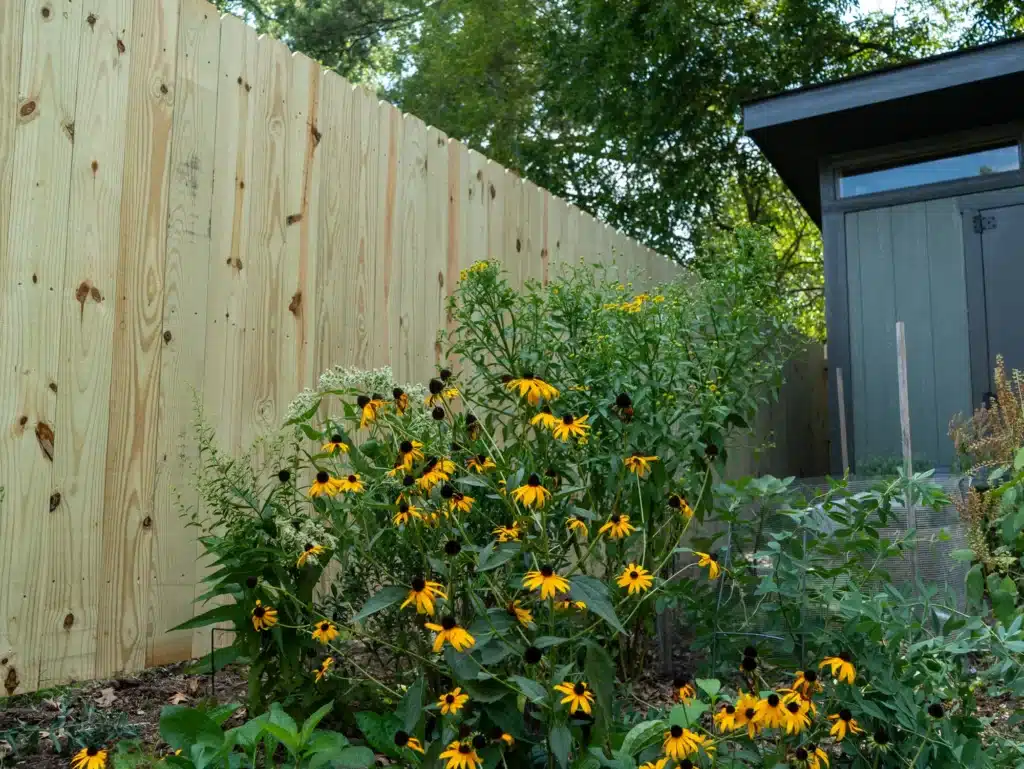
Dog-Ear Privacy for a Planted Richmond City Garden
A 6 ft pine privacy fence around a mature Richmond city garden, built without disturbing a single bed, with a framed walk gate beside the shed and a wood double gate at the driveway.
Why are two quotes for the same fence hundreds of dollars apart?
Nine times out of ten, one of them is a panel fence and the other is built on site. Pre-fab panels arrive 8 ft wide and finished, so the crew sets posts to suit the panel and hangs them. It is quick, and on flat ground it looks fine.
By contrast, a stick-built fence is cut and assembled in your yard: posts first, then rails run to the grade, then every board fastened one at a time. That takes hours a panel job does not, and it is why the fence follows a dip instead of hopping over it. Every fence we build is stick-built on site, with no pre-fab panels and no gaps underneath.
The other gap between quotes is usually in the details nobody itemises: post depth, the grade of the fasteners, whether gate posts are set deeper, whether the old fence goes away. Ask each bidder those four questions and most of the mystery disappears. Our side-by-side on premade versus stick-built wood fences walks through where the labor hours actually go.
Is wood cheaper than vinyl, aluminum or chain link?
Up front, wood fence cost in Virginia sits in the middle. Chain link is the cheapest way to enclose a yard, wood privacy comes next, and vinyl and aluminum cost more per foot to install. HomeGuide's installed ranges line the four materials up like this.
| Material | Installed, per linear foot | Upkeep |
|---|---|---|
| Chain link | $10 to $40 | Almost none, and no privacy |
| Wood | $20 to $50 | Clean and seal every few years |
| Vinyl | $30 to $60 | Wash it, nothing else |
| Aluminum | $25 to $75 | No painting or treating |
For example, on a 150 ft back yard, that is a difference of a few thousand dollars between wood and vinyl on day one. Over twenty years, however, the gap narrows, because wood is the one on that list that wants sealing and the occasional board. If you are weighing the low-maintenance options against each other, our breakdown of chain link versus vinyl fence costs covers that side of the decision.
How to lower your wood fence cost in Virginia without regretting it
There is a right way and a wrong way to take money out of a fence. The right way changes the scope. In contrast, the wrong way takes it out of the parts holding the fence up, and you pay it back in five years.
Trim here
- Drop from 6 ft to 4 ft on runs nobody overlooks
- Order one walk gate rather than two
- Use spaced picket where you want a boundary, not a screen
- Share the cost of a boundary run with your neighbor
Not here
- Post depth, or the concrete that holds the post
- Coated or hot-dipped fasteners that will not bleed rust
- A rot board where the boards meet wet ground
- Gate bracing and hardware on anything you open daily
Board spacing is worth a conversation too, because boards shrink as they dry and a gap set wrong turns a privacy fence into a semi-privacy one. Our guide to ideal wood fence spacing explains how we set it, and our note on installing a rot board covers the one piece of wood worth adding rather than cutting. If the issue is the lump sum rather than the fence itself, fence financing through Wisetack starts at 0% APR, and checking whether you qualify does not touch your credit score.
How to get an accurate wood fence cost for your Virginia yard
To get an accurate wood fence cost for your Virginia yard, start before you call anyone: walk the line with a tape or a measuring wheel and write down the total feet, where you want gates, and how wide the widest gate needs to be. Note anything in the way: a shed, a slope, a big tree, an air conditioner. A photo of the property line and any survey pins saves everybody time.
Then, on the visit, we walk the property, take the measurements ourselves and price the exact fence you asked for. We have been building fences for Richmond neighbors since 2006, and we build across Richmond, Henrico, Chesterfield, Glen Allen, Midlothian, Mechanicsville, Ashland, Hanover County, Powhatan and the rest of Central Virginia. See the styles we build on our wood fence installation page, then tell us which one caught your eye.
Wood fence cost questions from Virginia homeowners
How much does a 100 ft wood fence cost?
Figure $2,500 to $5,000 for 100 ft of 6 ft pressure-treated privacy at $25 to $50 a foot, before gates and tear-out.
How much does a 200 ft wood fence cost?
About $4,000 to $10,000 installed in HomeGuide’s figures. The per-foot rate drifts down on longer runs because setup and travel spread across more fence.
Does the price include removing my old fence?
No. Demolition is quoted separately, at about $3 to $10 per linear foot in national figures. Old posts set in concrete are the slow part, so tell us what is there.
How much does a gate add to a fence quote?
A standard wood walk gate runs about $245 to $568 installed and a double drive gate about $483 to $1,007. Gates carry heavier posts, bracing and hardware, which is why they cost more than the same width of plain fence.
Do I need a permit for a fence in Virginia?
It depends on your locality and what the fence does, and pool barriers face stricter rules. Check with your city or county and your HOA before you build.
Is wood cheaper than vinyl for a privacy fence?
Yes, up front: $20 to $50 a foot for wood against $30 to $60 for vinyl in HomeGuide’s ranges. In return, wood needs cleaning and sealing every few years.
Keep reading