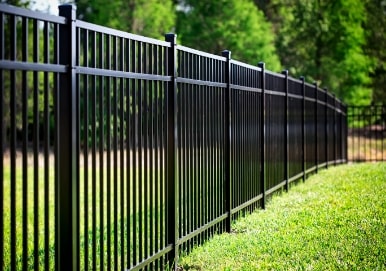




Virginia pool fence requirements start with a barrier at least 48 inches tall, measured on the side that faces away from the water, with no opening that lets a 4-inch sphere pass and a gate that closes and latches on its own. No more than 2 inches may sit between the ground and the bottom of the barrier. Your locality can ask for more, and the building official who inspects the yard has the final say.
At a glance
- The top of the barrier sits at least 48 inches above grade, measured from outside the fence.
- No opening in the barrier, pickets included, may pass a 4-inch sphere.
- No more than 2 inches between grade and the bottom of the barrier.
- Pedestrian gates swing away from the pool, close by themselves and latch by themselves, with the latch on the inside face.
- Under Virginia pool fence requirements, you cannot use the pool until the inspector approves the barrier.
What do Virginia pool fence requirements cover?
The barrier rules sit in Section 305 of the Virginia Swimming Pool and Spa Code. King George County’s summary of Section 305 puts the reach of it plainly. The Virginia Residential Code wants a compliant barrier or fence around any structure built for swimming. Spotsylvania County says the same thing from the counter side: the code makes no distinction between in-ground, above-ground or inflatable pools, hot tubs or spas.
Virginia pool fence requirements, with the code behind each number
| Requirement | The number | Where it comes from |
|---|---|---|
| Barrier height | Not less than 48 inches above grade, measured on the side facing away from the pool | VA Swimming Pool and Spa Code 305.2.1 |
| Gap under the barrier | 2 inches between grade and the bottom of the barrier | Spotsylvania County pool handout |
| Openings and picket spacing | Nothing that passes a 4-inch sphere | King George County, Section 305.2.2 |
| Barrier mounted on an above-ground pool wall | No more than 4 inches between the top of the pool structure and the bottom of the barrier | City of Salem barrier handout |
| Climbable equipment | Pumps, filters and heaters outside the barrier sit at least 36 inches from it | King George County, Section 305.2.9 |
| Poolside setback | The pool side of the barrier sits at least 20 inches from the water’s edge | King George County, Section 305.2.10 |
| Gates | Open outward away from the pool, self-closing, self-latching, latch on the inside face | Spotsylvania County pool handout |
| Covers in place of a fence | A powered safety cover complying with ASTM F1346 can stand in for a fence-style barrier | VA Swimming Pool and Spa Code 305.1 |
These are minimums, not the finish line
A county, a city, or your HOA can ask for more. The inspector decides whether what you built matches the code. Inspectors take the measurement that counts on the outside of the fence. That is why a yard that falls away from the pool can pass at the patio and fail 40 feet downhill.
Know before the inspector knows
Our crew measures the pool enclosure, flags anything on this page that will fail, and prices the fix or the full barrier. No charge, and no pressure.
In-ground, above-ground and spas: how the requirements change
For an in-ground pool, the barrier is a fence, a wall, or a mix of both, and the whole pool area sits inside it. For an above-ground pool, the pool wall itself can do the job: Section 305.5 allows it where the bottom of the wall is on grade, the top stands at least 48 inches above grade around the entire perimeter, the wall meets the rest of Section 305, and the pool manufacturer allows the wall to serve as a barrier.
That is where the ladder decides it. Where the pool wall is the barrier, Spotsylvania County spells out the ladder rule. You remove the ladder or steps when nobody is using the pool, or you surround them with a barrier and a gate that meets the gate rules. A deck built against the pool changes the answer again, because the deck gives a route in that the pool wall no longer guards. Expect the barrier to take in the deck and its steps, and confirm the layout with your building official before you frame it.
Hot tubs and spas are not exempt either. A powered safety cover that complies with ASTM F1346 can stand in for a fence-style barrier. A pool gets a fence.
Can my house wall count as one side of the pool barrier?
Yes, and most Richmond-area backyards are built that way. The trade-off is that the doors and low windows leading from the house to the pool become part of the barrier, so the code asks for extra protection on that side. Salem’s handout of the state rule lists a powered safety cover complying with ASTM F1346 as one accepted route, with alternative protections on the openings as the other.
Ask your building official which alternative the county accepts before you plan around it. Permit counters interpret this part of the rule more differently than any other. If alarms on the back door sound like an annoyance, the other option is a four-sided fence that keeps the house outside the barrier. It costs more fence, and it is the layout inspectors argue with least.
Do I need a permit for a pool fence in Virginia?
A plain backyard fence usually needs no building permit in Central Virginia. A pool barrier is different, because the inspector checks it against Virginia pool fence requirements as part of the pool. Chesterfield County’s pool handout requires a building permit for a swimming pool over a set size and asks for two documents with the application: a plot plan showing the proposed distances, and two sets of construction drawings.
How a pool barrier permit usually runs
- Confirm with your locality’s building office whether the barrier goes on the pool permit or its own.
- Submit a plot plan showing the property lines, the house, the pool and the fence line with setbacks.
- Get the permit issued before posts go in the ground.
- Build the barrier, including the gates and their hardware, not just the fence runs.
- Call for the final building and barrier inspection, and keep the pool out of use until it passes.
The inspection is the part people forget
That last step is not a formality. Spotsylvania lists a final building and barrier inspection among the approvals a pool needs. Pools shall not be used until the required inspections of the pool, barrier and electrical equipment have been approved.
Richmond, Henrico, Hanover, Chesterfield and Powhatan each run their own counter, and the paperwork differs more than the code does. One call to the building office answers the two questions that change your schedule: who pulls the barrier permit, and when the inspection happens relative to filling the pool. Make that call before you buy material.
Does your fence meet Virginia pool fence requirements?
Plenty of yards are one gate away from passing.
The ten-minute tape measure check
- Measure the fence height from the ground on the outside, at the highest and the lowest point of the run.
- Slide the tape under the fence at every low spot, especially where the ground falls away.
- Try a 4-inch ball, or your fist, between the pickets and anywhere the fence meets a post, a wall or the house.
- Stand outside and look for footholds: horizontal rails on the outside face, a pool pump, a woodpile, an AC unit, a retaining wall.
- Open each gate wide, let go, and watch whether it closes and latches without a hand on it.
Fix the gate first
The gate is the weak link in any pool barrier. A gate that closes but does not latch completely leaves the whole fence open. Fit self-closing hinges and a self-latching latch on the inside face, high on the gate, before you spend money on anything else.
Common fails and what fixes them
To close a gap under a fence on a sloped run, reset the panels to follow grade or add a kicker board or stone at the low points. A crew can cut out horizontal rails on the outside face and re-hang the fence with the rails inside. Pickets too far apart take an infill panel or a new section, and there is no safe shortcut on that one.
Most of these are retrofits rather than a new fence, so have the run measured before you assume you are starting over. The honest comparison is the cost of new gates and a few reset panels against the cost of a fresh barrier, and that only becomes clear once someone has walked the line with a tape.
Which fence types pass, and what do they cost?
Aluminum pool panels are the default here for a reason. Their picket spacing already meets the 4-inch rule in the Virginia pool fence requirements. The rails can sit where there is nothing to climb from outside, and the finish takes chlorine splash-out without rusting. On a Richmond job our crew noted that aluminum “is durable, resists corrosion and needs very little maintenance”, which is the honest case for it around water.
Vinyl and wood privacy fences pass the openings test, since a solid panel has none. They fail more often on the two details nobody checks: the gap at the bottom on a sloping run, and gate hardware that cannot close by itself. Chain link passes the sphere test, yet standard diamond mesh gives a child a toe-hold, so ask your inspector how they treat it before you count on an existing chain link run. A removable mesh fence has its own rule to watch: the inside of the mesh must sit at least 20 inches from the nearest edge of the water, per Section 305.2.4.1.
What the price follows
Gates, grade and length move a pool fence price more than style does. Each code-compliant gate carries hardware the fence runs do not. A sloped yard takes more posts and more labor to keep the gap closed. And a four-sided enclosure runs longer than most people estimate before they measure it. See what aluminum fencing costs for how the pieces add up, and aluminum pool fence ideas for styles that meet the spacing rule. For a real number on your yard, we walk your property, take measurements, and give you a clear price, gates included, rather than a per-foot average that ignores your grade.
How we build pool fences to meet Virginia requirements
Every fence is stick-built in your yard rather than hung as pre-fab panels, so the fence follows the grade and leaves no gap underneath. That matters more at a pool than anywhere else, because inspectors measure the 2-inch rule at the worst point of the run, not the average. Our notes on installing aluminum fencing on a slope cover how we rack or step a run to keep the bottom tight to the ground.
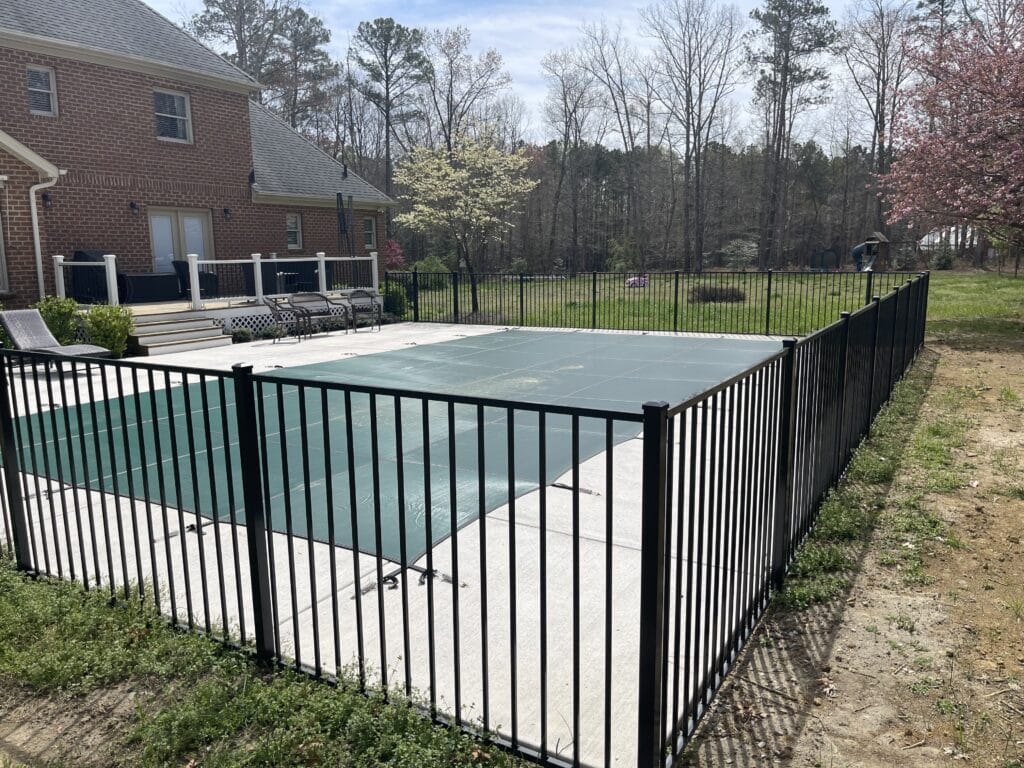
Black flat-top aluminum enclosing an in-ground pool and its concrete deck in Richmond.
On that Richmond pool job, the fence sits in the lawn just beyond the concrete deck, so the deck and its lounge chairs stay inside the barrier, and the layout follows the contours of the pool area instead of boxing it into a rectangle. Our crew finishes most full installations in one to two days. We are a family-owned company that has built fences since 2006. We serve Richmond, Mechanicsville, Chesterfield, Henrico, Glen Allen and Midlothian, and we build aluminum fence installation to the barrier spec above.
Gate hardware is the part to settle early, since the hinges and latch have to suit the weight and swing of each gate, and they are what the inspector tests first. If you want the barrier standing before the pool opens, start in late winter: the permit, the measure and the build all sit ahead of your first swim.
Questions people ask
How tall does a pool fence have to be in Virginia?
Virginia pool fence requirements call for at least 48 inches, measured on the side of the fence facing away from the pool. On a sloped yard, check the low side too.
Do I need a fence around an above-ground pool in Virginia?
Yes, unless the pool wall does the job: at least 48 inches tall all the way around, approved by the manufacturer for that use, with a removable or gated ladder.
Does a privacy fence around my yard satisfy the pool barrier rule?
Often on height and openings. Gates and gaps usually need work: gates must swing away from the pool, self-close and self-latch, and the bottom gap must stay within 2 inches.
What spacing between pickets is allowed on a pool fence?
Any spacing that will not pass a 4-inch sphere. Standard residential pool panels meet that limit. Older ornamental or farm-style fences often do not.
How far from the pool edge does the fence have to be?
The barrier sits at least 20 inches from the water’s edge, and climbable equipment sits at least 36 inches outside it. Your locality sets the property-line setback, covered in Virginia fencing regulations on property lines.
Keep reading
Sources
- Virginia Swimming Pool and Spa Code, Chapter 3 General Compliance
- King George County, Swimming Pool and Spa Barrier and Bonding Requirements, 2021 ISPSC and VRC
- City of Salem, Barrier and Safety Requirements for Residential Pools, Spas and Hot Tubs
- Spotsylvania County, Requirements for Outdoor Residential Swimming Pools
- Chesterfield County, Requirements for Outdoor Residential Swimming Pools