
The most popular farm fence designs in Virginia are board paddock fences, crossbuck fences, split rail and ranch rail, plus wire-backed versions of each. The right one depends on what the fence has to hold, how far it runs and how much upkeep you want.
Good Neighbor Fence builds board, crossbuck and rail fences for horse properties, hobby farms and country homes across Central Virginia. Below, you’ll see what each design looks like and where it works. You’ll also get extension guidance for horses and livestock, plus how Virginia law defines a lawful fence.
Farm Fence Designs at a Glance
Here’s a quick side-by-side of the main farm fencing options. Then each one gets a closer look below.
| Design | What it looks like | Best for | Keep in mind |
|---|---|---|---|
| Board paddock | 3 or 4 flat boards on wood posts | Horses, pastures, road frontage | Fasten boards on the animal side; wood needs upkeep |
| Crossbuck | An X brace between top and bottom rails | Country homes, driveways, paddocks | Open X gaps need mesh to hold small animals |
| Split rail | Rough rails set into holes in the posts | Boundaries, driveways, garden edges | Not a livestock or pet fence without mesh |
| Ranch rail | Smooth rails on posts, often in vinyl | Low upkeep boundaries and horse areas | Match height and rail spacing to your animals |
| Wire-backed | Mesh fastened to the inside of rails or boards | Dogs, goats, sheep, poultry, kids | Choose mesh by animal; horses need woven mesh |
Board Paddock Farm Fences
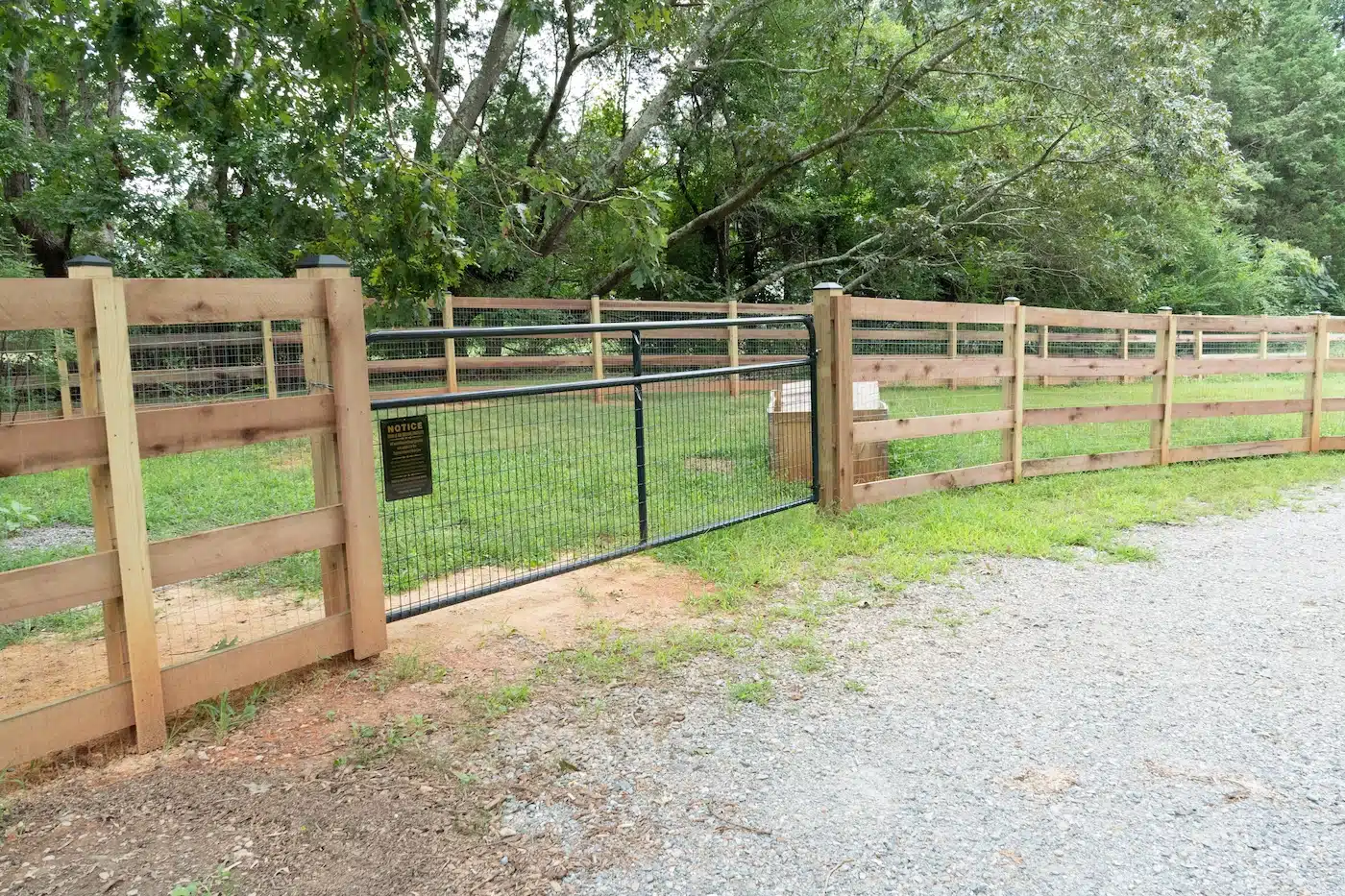
Of all the farm fence designs, a board paddock fence is the classic horse farm look: three or four flat boards fastened to wood posts, often in pressure-treated lumber. Because it reads as a solid line, horses see it clearly. University of Georgia Extension notes that painted rail fences are highly visible, so horses treat them as a solid barrier and are less likely to run into them.
Height and board placement matter more than style. Penn State Extension recommends horse fences stand 54 to 60 inches tall. It also advises fastening rails and mesh to the inside (horse side) of the posts, so a leaning horse can’t push the fasteners out.
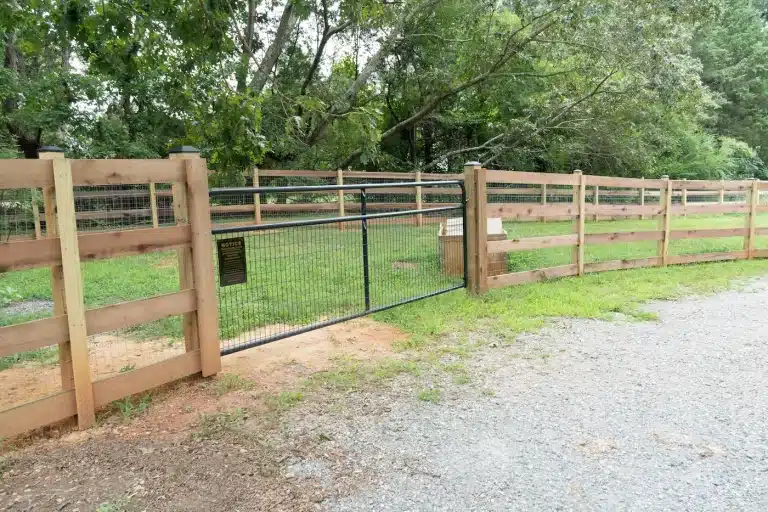
On a Goochland horse property, we built a 4 board paddock fence in pressure-treated lumber with black post caps. The runs follow the natural contours of the pasture, from the road frontage back along a gravel lane. You can see more photos on the Goochland paddock project page.
Crossbuck Fences for a Classic Farm Look
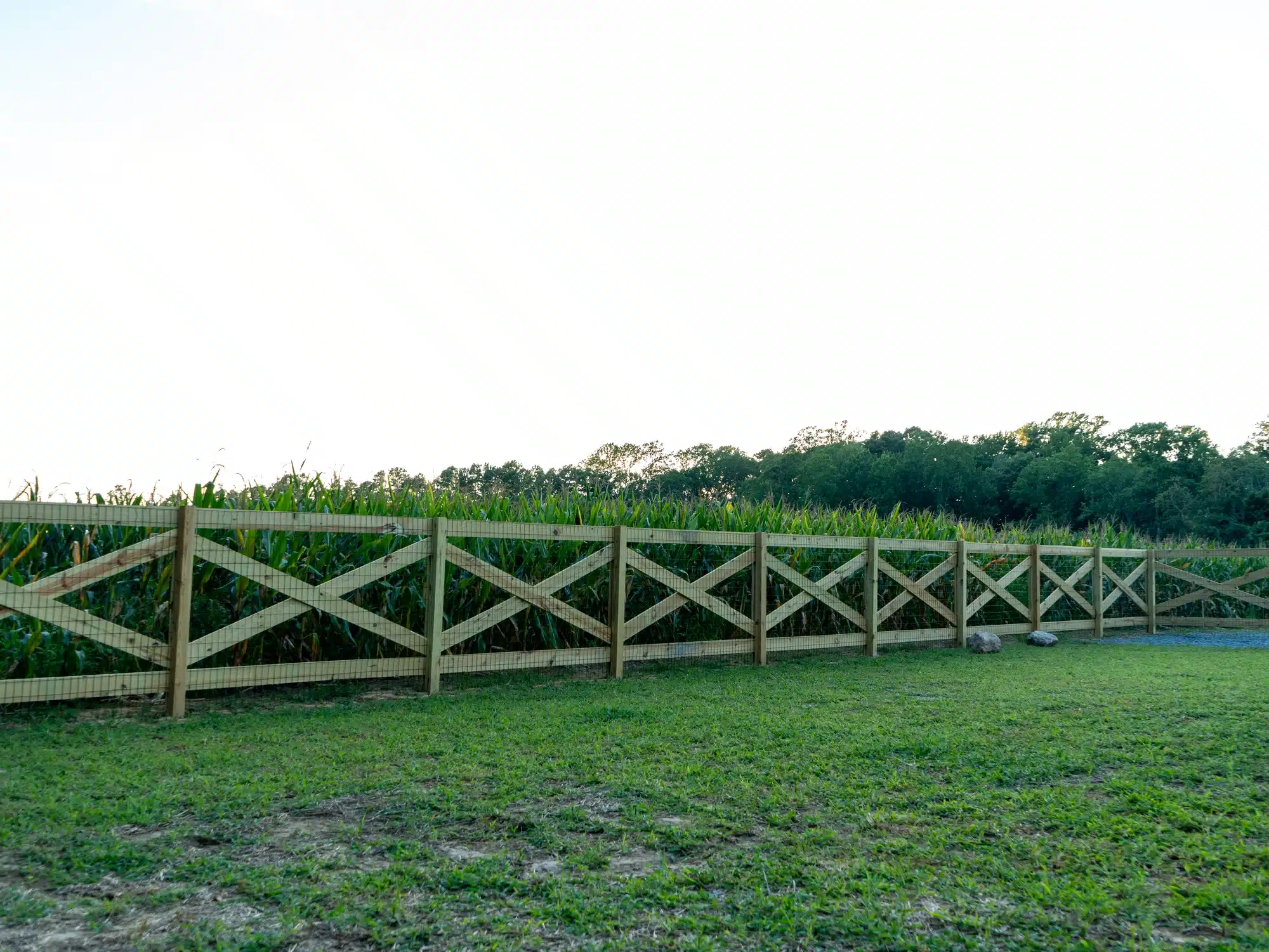
A crossbuck fence adds an X brace between the top and bottom rails of each section. It gives a long run more visual weight than plain rails, so it suits a farmhouse frontage, a driveway or a show paddock.
The X leaves wide triangular gaps, though. On its own, crossbuck marks a boundary well, but it won’t hold dogs, goats or poultry. For that, add wire mesh on the inside. We’ve built crossbuck paddock fences with wire backing and wire-backed double gates for rural Virginia properties.
Split Rail and Ranch Rail Farm Fences
Split rail is the most rustic of the farm fence designs here. Rough rails, usually two or three per section, slide into holes cut through the posts, so there’s little hardware to rust or loosen. It marks a property line, frames a driveway or edges a garden with an open, natural look.
Since the rails sit far apart, split rail won’t contain most pets or livestock unless you add mesh along the inside. Our guide on how to install a split rail fence in Virginia covers layout, post holes and setting the rails.
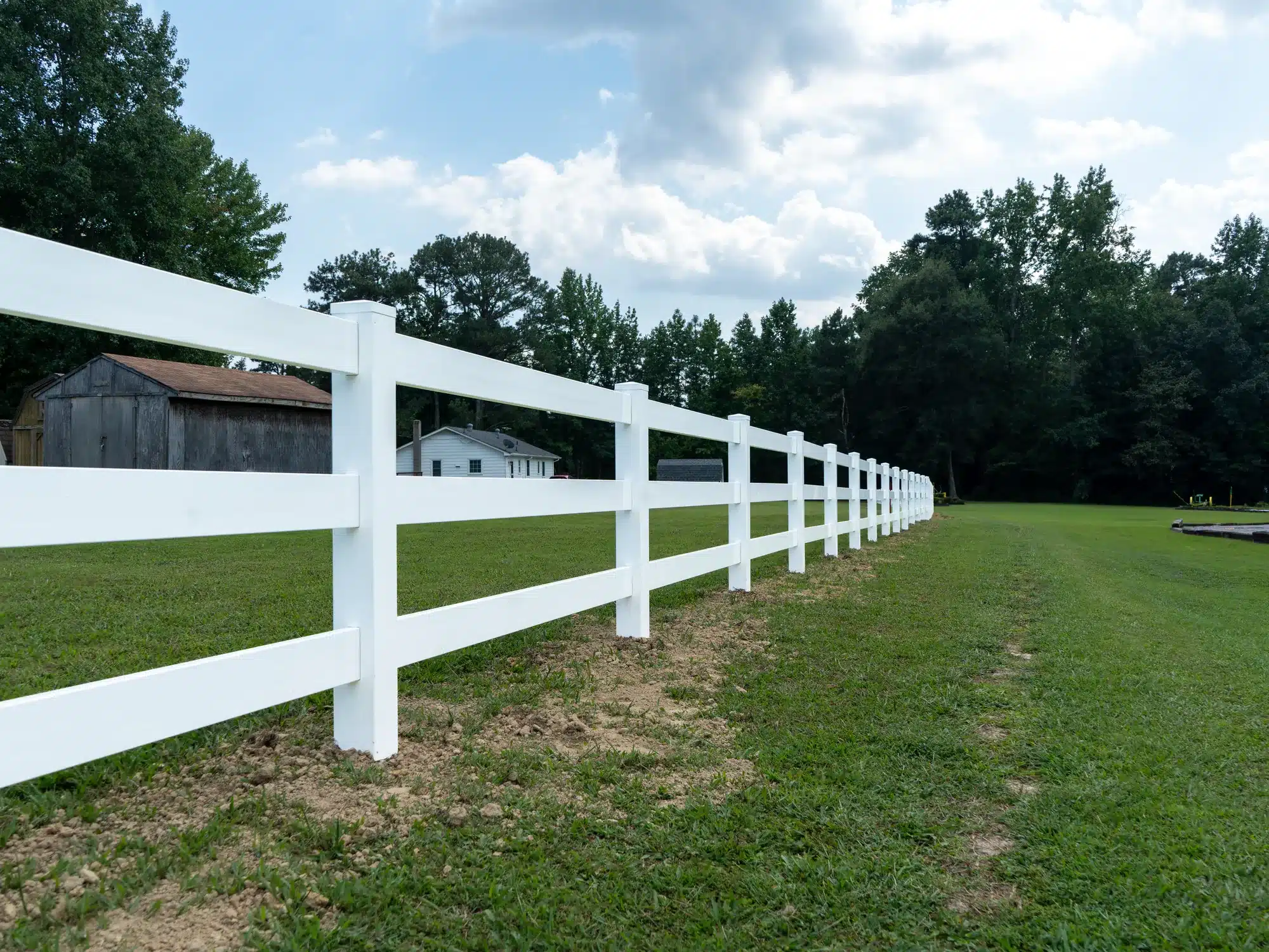
Ranch rail (also called post and rail) uses smooth rails fastened to posts instead. In vinyl, it keeps the farm look without painting or staining, so it’s a common pick for owners who want less upkeep. Read about the benefits and limits of a vinyl split rail fence before you decide.
Wire-Backed Farm Fence Ideas
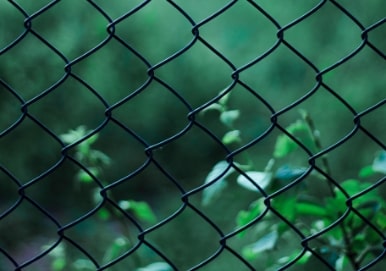
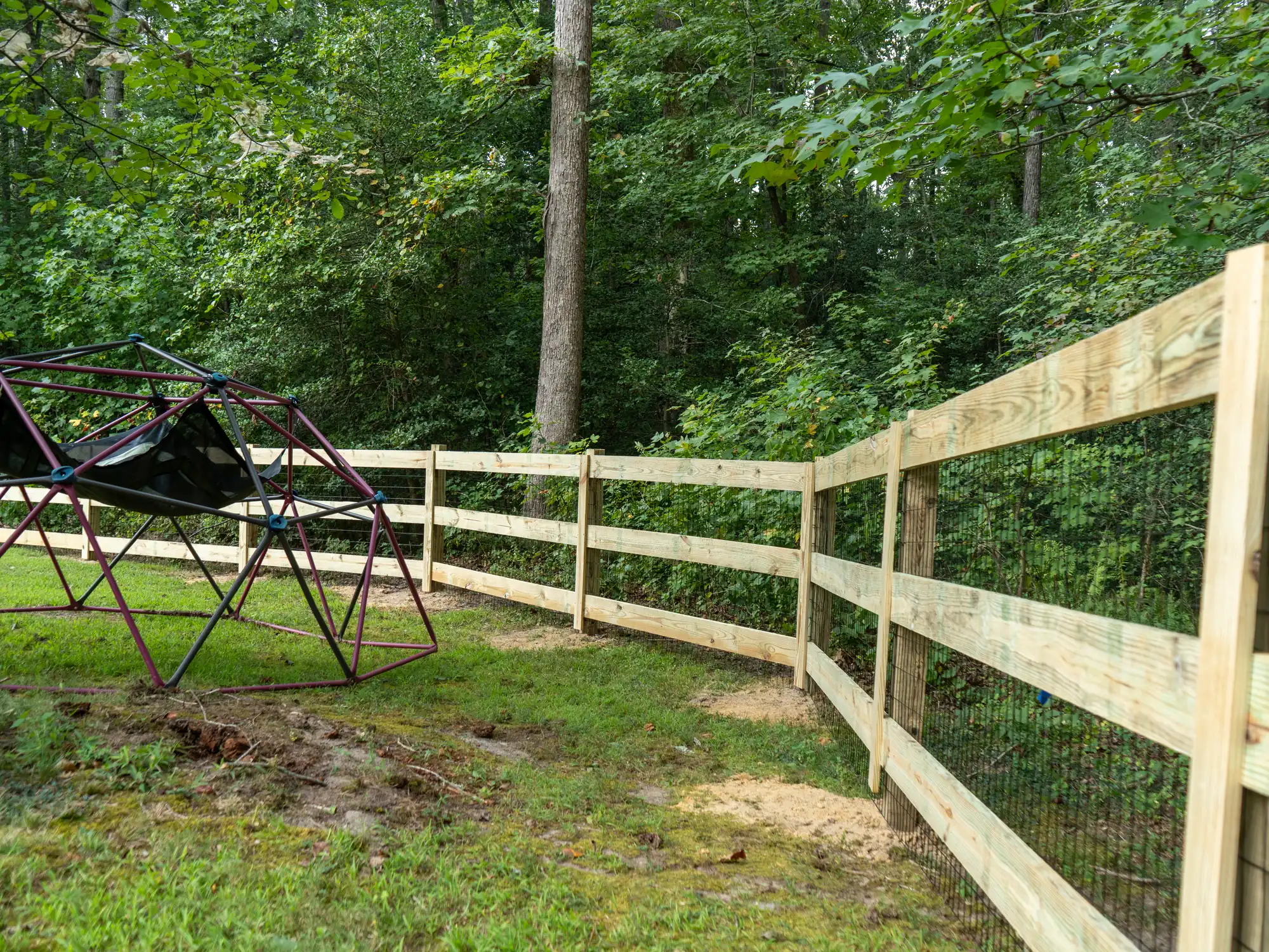
Adding wire mesh to the inside of a board, crossbuck or rail fence keeps the open farm look while closing the gaps. It’s the simplest way to make a farm-style fence hold dogs, goats, sheep, chickens or small children.
The type of mesh matters. For horses, UGA Extension recommends woven mesh with 2 by 4 inch openings, which keep hooves from getting caught. But it doesn’t recommend welded wire for horse fencing, because the joints won’t hold up under field conditions.
Welded wire still has a place behind a dog yard or garden fence. On our Goochland paddock, for example, welded wire mesh runs behind the boards close to the farmhouse and at the drive. You can do the same: put mesh where pets, kids or small stock spend time, and leave long pasture runs open. For more combinations, see these wood and wire fence ideas.
Farm Style Fences for Backyards and Privacy
You don’t need acreage to use a farm fence design. A 3 board paddock or crossbuck fence around a backyard gives a house a country look. Then wire backing turns it into a yard fence for pets.
Rail fences are open by design, so they won’t give you privacy. If you want a farm privacy fence, mix styles instead: an open paddock or crossbuck along the front or pasture side, and a solid privacy fence around the patio, pool or back lawn. A board-on-board section from our wood fence installation team, or a panel from our vinyl fence installation line, keeps the farmhouse feel while blocking the view.
If you live in a subdivision, check your HOA covenants before you pick a style or height. Our tips on installing a fence in an HOA can help you prepare the request.
How Do You Choose a Farm Fence for Your Animals?
Start with the animal, then the layout. A fence that holds cattle may injure a horse, and a horse fence won’t necessarily stop a goat. Here’s what extension specialists recommend as you weigh farm fencing options for each.
Horses
Aim for 54 to 60 inches, strong visibility and smooth surfaces. Board, crossbuck and rail fences with woven mesh are all common horse choices. Penn State also suggests about 8 inches of clearance under the bottom board, so a hoof won’t get trapped. Our guide to choosing horse fencing compares the options in more detail.
Goats and Sheep
Small ruminants test every gap. Virginia Cooperative Extension recommends a strong perimeter fence of woven wire or multi-wire high-tensile electric. It adds that for sheep and goats, close-spaced woven wire also helps keep predators out. So on a board or rail fence, plan on mesh along the inside of every run.
Cattle
Cattle lean and push, so strength matters more than looks on large pastures. Those perimeters are typically woven wire or high-tensile electric. But board farm fences still work well for pens, small lots and road frontage where appearance counts.
Dogs, Poultry and Gardens
Pick mesh with openings small enough for the smallest animal, and fasten it to the inside of the fence. If your dog digs or jumps, height and a tight bottom edge matter too. Our guide to the best fence for dogs covers sizes and materials.
What Is a Lawful Fence in Virginia?
Virginia law sets a baseline. Under Virginia Code § 55.1-2804, a board, plank or rail fence counts as a lawful fence when it stands at least 42 inches high with at least three boards firmly attached to posts. A barbed wire fence needs at least four strands at 42 inches or more, on posts no more than 12 feet apart.
That’s a legal floor for farm fences, not a design target. A 42 inch, three board fence meets the statute but sits well below the 54 to 60 inches Penn State recommends for horses.
Zoning and HOA rules are separate from this statute. Counties set their own height and setback limits, so check them before you build near a road or boundary. Our guide to Virginia fencing regulations on property lines explains the basics.
Planning Gates, Lanes and Layout
On farm fences, gate placement matters as much as the rails. For grazing paddocks, Virginia Cooperative Extension advises putting gates in corners rather than mid-fence, and adding lanes so you can move stock between paddocks. Horse owners often do the opposite. Penn State notes that gates usually sit toward the middle of a horse fence line, because horses are led in and out one at a time.
Also size each gate for the biggest thing that will pass through it, such as a mower, tractor or horse trailer. Then plan the gates into the fence from the start, since gate and corner posts carry heavier loads than line posts.
Before you ask for quotes on any of these farm fence designs, measure the total footage. Our breakdown of what it costs to fence an acre shows how material choice changes the total. For the build itself, this step by step installation guide for rural properties walks through each stage. Finally, contact Virginia 811 at least 3 working days before anyone digs; marking public utility lines is free.
Get a Quote for Your Farm Fence
Good Neighbor Fence has been family owned since 2006 and has earned 400+ five-star Google reviews across Central Virginia. We build farm-style fences from Goochland and Powhatan to Hanover and New Kent. Tell us what the fence needs to hold and how far it runs, and we’ll help you match one of these farm fence designs to the job.
Get a fast, free quote or call (804) 737-4664. If you’d like to spread out payments, financing through Wisetack starts at 0% APR for qualified buyers.