

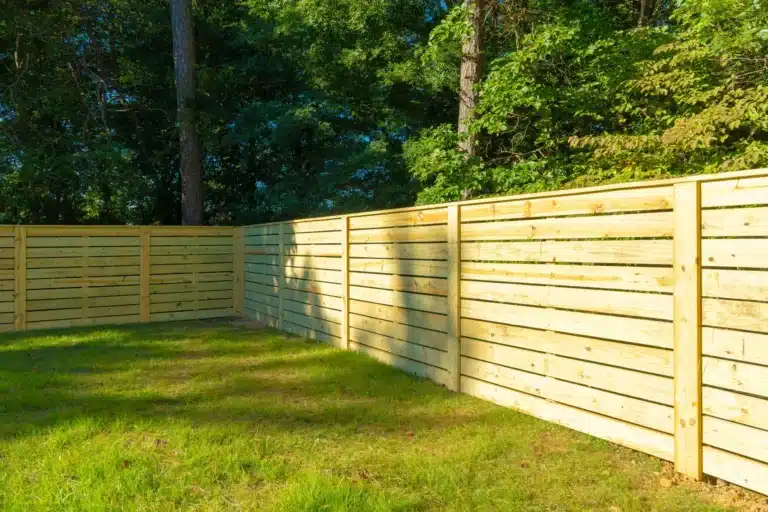
The best horizontal fence ideas keep the boards level, the gaps even and the frame stiff enough to stay straight for years. Start with how much privacy you want, then choose a board layout, a trim detail and a gate that carries the same lines across the yard.
A horizontal wood fence looks modern because your eye follows the boards across the yard instead of up and down. That long line makes a small lot feel wider. It also suits simple landscaping, dark window frames and newer homes with clean lines. Below you will find 10 horizontal fence ideas that work in Central Virginia yards, how to make one last, and how it compares with a vertical fence.
Good Neighbor Fence builds horizontal semi-privacy fences as one of our custom wood fence styles. Like every wood fence we build, it is custom stick-built on site and fitted to your landscape instead of hung as premade panels. Still choosing a material? Our guide to privacy fence ideas compares the options.
- Tight gaps give full privacy. Narrow, even gaps give semi-privacy with light and air.
- Each board spans post to post, so tight post spacing or a center support keeps it from sagging.
- Use hot-dipped galvanized or stainless steel fasteners, two per board at each post.
- A horizontal fence usually costs more than a vertical fence of the same size.
- Our wood fences are custom stick-built on site, not hung as premade panels.
10 Horizontal Fence Ideas for a Modern Yard
Each of these horizontal fence ideas starts with the same base: level boards on solid posts. What changes is the gap, the trim and the materials around it.
1. Tight-Board Horizontal Privacy Fence
For full privacy, run the boards with only a slim gap between them. That gap matters, because boards shrink and swell across their width as the weather changes. Treated pine often goes up damp, so gaps tend to widen as it dries. Keep the gap small and consistent, and you get privacy without boards pushing against each other in wet weather.
2. Semi-Privacy Horizontal Fence With Narrow Gaps
If you want light and a breeze in the yard, space the boards with narrow, even gaps. This semi-privacy layout suits a patio, a garden or a side yard where you want the space defined but not closed in. A spacer block cut to the same size for every course keeps the gaps even from end to end.
3. Mixed Board Widths for a Custom Pattern
Alternate wide and narrow boards to give a plain fence a rhythm that looks custom. For example, pair a 6 inch board with a 4 inch board, or add a wider gap every few courses to create bands. Repeat the same pattern on every section, and sketch it first so the top board lands where you want it.
4. Cap and Trim Frame Around Each Section
A top cap and a vertical trim board over each post turn a horizontal wood fence into a row of framed panels. The trim covers the board ends at the posts, which is where cuts and fasteners show the most. It also gives the fence a finished edge that reads well from the house and the street.
5. Wood Paired With Black or Bronze Aluminum
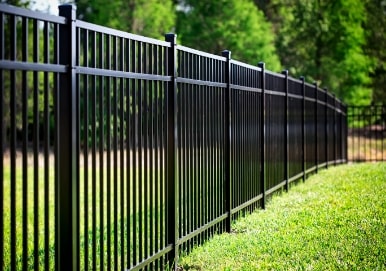
Mixing materials is one of the easiest ways to make a modern horizontal fence stand out. Keep solid wood where you need privacy, such as along the back of the yard. Then switch to ornamental aluminum fencing where you want an open view, a decorative walk gate or a clear line of sight to the driveway.

6. Steel Posts and Metal Accents
Metal can do structural work as well as add style. Steel posts will not rot at the ground line the way wood posts can, and wood trim can wrap them so the fence still looks all wood. A dark metal cap or a slim metal post adds a contrasting line between sections. Our guide to steel or wood fence posts covers the tradeoffs.
7. Contrasting Tones and Finishes
Dark posts and trim against natural boards, or light trim against darker boards, give a horizontal wood fence a sharp, architectural look. Bare cedar and treated pine tend to weather to a silver gray, so decide early if you like that look or want a finish. Good Neighbor Fence does not stain fences, but our tips on sealing a wood fence cover timing and prep if you plan to do it yourself.
8. A Matching Horizontal Gate
The gate is where a modern fence looks its best or its worst. Build it as part of the fence project with the same boards, gaps and trim, so the lines carry straight across the opening. A wide horizontal gate also needs a stiff frame or a diagonal brace behind the boards to keep the latch side from dropping. See more layouts in our wood fence gate designs.

Wood privacy runs the side lines, while Kinsale vinyl with aluminum balusters keeps the river view open.
9. Horizontal Screens for Small Yards and Patios
A small Richmond backyard does not always need a full perimeter fence. A few horizontal screen sections can block a neighbor’s view of your patio, hide trash cans or AC units, or give a hot tub a private corner. Because the boards run sideways, even a short screen makes a tight space feel wider instead of boxed in.
10. Horizontal Fencing for Commercial Properties
The same look works for restaurant patios, office courtyards and apartment amenity areas, where a modern horizontal fence reads clean and professional. Commercial fences see more traffic, so sturdy gates and heavier hardware matter even more. Our post on commercial fence options compares materials for businesses.
Tell us about your yard and get a fast, free quote for the fence you want.
- Family owned since 2006
- Most installs take 1 to 2 days
- Financing from 0% APR for qualified buyers
or call (804) 737-4664
Do Horizontal Fences Last? How to Prevent Sagging and Warping
Yes, when it is framed for the job, and that applies to all of the horizontal fence ideas above. On a vertical fence, rails carry the pickets. But on a horizontal wood fence, each board spans from post to post on its own, so long spans, moisture and weak fasteners show up faster.
Keep Post Spacing Tight or Add a Center Support
Long spans are the main reason horizontal boards sag or bow. Many builders set posts closer together than they would on a vertical fence. Others add a vertical nailer at mid-span, so each board is fastened in three places instead of two. Before you sign, ask how far apart the posts will be and what supports the middle of each board.
Choose Thicker, Straighter Boards
Thin boards cup and twist more easily, and on a horizontal fence every bend shows along the whole run. Thicker boards in a better grade, with fewer large knots, stay flatter over time. So the longer the span between posts, the more board thickness matters.
Use Fasteners Rated for Treated Wood or Cedar
Every board hangs on its own fasteners, so they need to last. The Western Wood Preservers Institute recommends hot-dipped galvanized or stainless steel fasteners for pressure-treated wood. For cedar, the Western Red Cedar Lumber Association recommends stainless steel screws to resist corrosion and staining. Two fasteners per board at each post also help keep boards from cupping.
Plan for Wood Movement
Wood shrinks and swells as its moisture content changes. The USDA Forest Products Laboratory Wood Handbook explains that wood moves most across the grain and only slightly along its length. On a horizontal fence, that movement runs top to bottom, so gaps open in dry weather and close in wet weather. Central Virginia swings from humid summers to drier winter air, which is why an even spacer gap beats butting boards tight.
Horizontal vs Vertical Fence: Which Is Right for Your Yard?
Choose horizontal if you want a modern look and a yard that feels wider. Choose vertical if you want the lower cost, a traditional style or a fence that follows sloped ground more easily. Here is how the two compare before you settle on any of these horizontal fence ideas.
| Factor | Horizontal fence | Vertical fence |
|---|---|---|
| Look | Modern, long clean lines | Traditional styles such as dog-ear, picket or board on board |
| Framing | Boards span from post to post | Pickets fasten to horizontal rails |
| Sloped yards | Boards look best level, so the fence usually steps down a hill | Pickets can follow the grade with no gaps underneath |
| Wood movement | Gaps open and close between boards | Gaps open and close between pickets |
| Relative cost | Usually higher | Usually lower |
| Best for | Modern homes, patios and small yards | Most privacy fences, sloped lots and tighter budgets |
Relative cost depends on height, footage, board grade and the site. A fast, free quote gives you a real number.
Most horizontal fence ideas assume fairly level ground, so slope is the biggest practical difference. Good Neighbor Fence wood fences are custom stick-built on site and fitted to the landscape with no gaps under the fence, and vertical boards make that easy on uneven ground. A horizontal fence on a hill usually steps down in level sections, so the space under each step needs a plan. Our guide to installing a backyard fence on a slope explains stepping and racking. To compare materials first, see the best fence for a sloped yard.

Privacy is close to even. A tight-board horizontal privacy fence blocks about as much view as a solid vertical fence of the same height. The difference is in how gaps appear as the wood dries: sideways slits on a horizontal fence, upright slits on a vertical one. For more options, see our privacy fence styles and the tips in our wood fence spacing guide.
What Drives the Cost of a Horizontal Wood Fence?
A horizontal wood fence usually costs more than a standard vertical privacy fence of the same height and length. The horizontal fence ideas above differ in cost mostly because of framing and board quality. These are the main cost drivers:
- Board grade and species: knots, warps and color changes show more on long, level boards, so many homeowners choose cedar or a higher grade of treated pine.
- Post spacing and supports: closer posts or center nailers add lumber and labor.
- Board thickness and gap layout: thicker boards and tight gaps use more material per foot of fence.
- Height and total footage: a taller or longer fence needs more boards, posts and hardware.
- Gates: a wide horizontal gate needs a stiff frame to stay square.
- Slope and site work: stepping down a hill, clearing brush or removing an old fence adds time.
Before you compare quotes, read our breakdowns of wood fence cost and privacy fence cost. Financing through Wisetack starts at 0% APR for qualified buyers, and our fence financing page explains how it works.
Horizontal Wood Fence Questions Homeowners Ask
What wood is best for a horizontal fence?
Cedar and pressure-treated pine are the two common choices. Cedar tends to stay straighter and has a warm color, while treated pine is the budget-friendly option. Pick straight, clear boards either way, because the long lines of a horizontal fence show every bow.
How tall can a horizontal privacy fence be?
Local zoning sets the limit. Virginia’s building code exempts fences from a building permit unless the fence is a pool barrier or a pedestrian safety fence (Virginia USBC Section 108.2). Counties then limit height by yard. Chesterfield County, for example, allows fences up to 7 feet in side and rear yards and 4 feet in front yards. For taller builds, see our tall wood fence ideas.
Can a horizontal fence go around a pool?
It can, with care. The CPSC pool barrier guidelines say horizontal members spaced less than 45 inches apart belong on the pool side, so a child outside cannot use them to climb. Pool barriers also need a building permit in Virginia, so plan that section with your installer and your county.
Get a Quote for Your Horizontal Wood Fence
Good Neighbor Fence has been family owned since 2006, with 400+ five-star Google reviews from homeowners across Central Virginia, including Richmond, Glen Allen and Midlothian. Most installs take 1 to 2 days. Request a fast, free quote or call (804) 737-4664 to talk through your horizontal fence ideas.
Tight city lots, where a few horizontal screens make a small yard feel wider.
Wooded backyards, like the Glen Allen horizontal fence at the top of this post.