


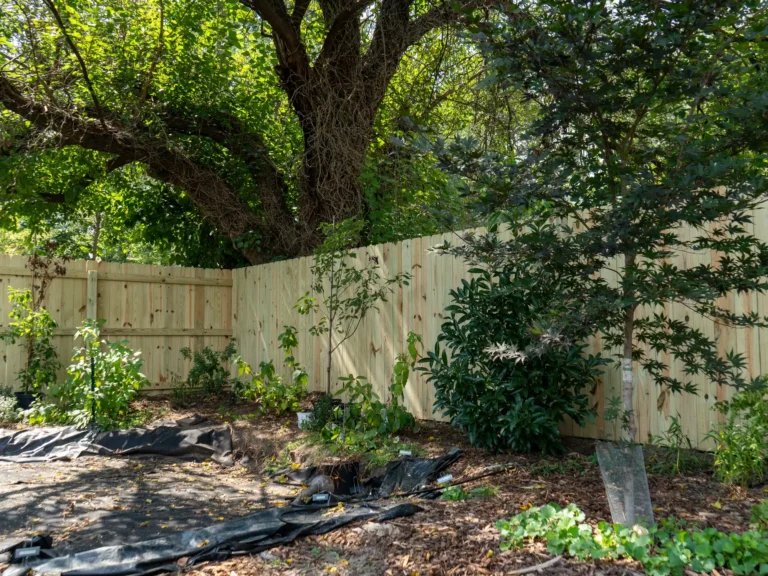
The best privacy fence ideas come down to three things: height, board layout and a tight fit to the ground. For most Virginia yards, that means a 6 foot wood or vinyl fence in a solid or overlapping board style.
Below, you’ll find the styles that block the most view, with photos from our own projects. You’ll also see Virginia height rules and a simple way to choose. Good Neighbor Fence has been family owned since 2006 and handles privacy fence installation across Central and Northern Virginia.
- A 6 foot fence blocks the view of people standing in the next yard, so it is the most common backyard privacy height.
- Board on board and shadowbox layouts overlap the boards, so thin drying gaps stay covered.
- Our wood fences are stick-built on site, with no gaps under the fence on sloped ground.
- Most Virginia fences need no building permit. However, local zoning still sets the height.
- Most installs take 1 to 2 days.
What Makes a Fence Truly Private?
A fence feels private when nobody can see in while standing, from a neighbor’s deck, or through the boards. So three details matter more than the material you pick: height, board layout, and the space under the fence. Get those right and almost any style will work.
Height Sets the Sightline
Height does most of the work. A 4 foot fence marks the property line, but most adults can see right over it. At 6 feet, a fence blocks the view of people standing in the next yard. That’s why it’s the most common backyard privacy height.
Sometimes a neighbor’s deck or a sloped lot puts eyes higher than yours. Then a taller fence, a lattice top or a planting bed can finish the screen. Local zoning sets the ceiling, so check the limits covered further down before you plan anything over 6 feet.
Board Layout Decides What Shows Through
A fence with boards butted edge to edge looks solid on install day. But wood shrinks and swells as its moisture changes, according to the USDA Forest Products Laboratory Wood Handbook. It moves most in the direction of the growth rings. On a fence, that means across the width of each board, so thin gaps can open as new lumber dries.
That’s why overlapping layouts matter for privacy. Board on board and shadowbox styles place boards on both sides of the rails. So a small gap on one side is covered by a board on the other. For exact numbers, see our guide to wood fence spacing.
Gaps Under the Fence
The gap people forget is the one along the ground. Premade panels, however, are flat along the bottom. On sloped or uneven ground, they leave open triangles where dogs can slip under and neighbors can see in. Our wood fences are custom stick-built on site and fitted to the landscape, with no gaps under the fence. You can compare the two approaches in premade panels vs stick-built wood fences.
Wood Privacy Fence Ideas
Wood gives you the most room to customize. You choose the board style, height, top and trim, and a stick-built fence can follow almost any grade. Pressure-treated pine is the usual choice for posts and rails here, since posts sit in damp soil. The Forest Products Laboratory notes that serious decay happens only when wood stays wet. It points to pressure-treated wood for ground contact. Our wood fence installation page shows the styles we build.
Solid Board Wood Privacy Fence: Dog-Ear, Flat or Concave Top
The classic stockade layout sets boards side by side on one face of the rails. It uses the least lumber of the full privacy styles, so it’s often the most budget-friendly wood option. The top, though, changes the look more than the privacy. Dog-ear boards have clipped corners, flat tops look cleaner, and a concave top dips between posts for a softer line.

Shadowbox: The Good Neighbor Wood Privacy Fence
A shadowbox fence alternates boards on each side of the rails, so both neighbors see a finished face. It lets some air pass through, so it catches less wind than a solid wall of boards. It also hides board shrinkage well. From straight on it reads as solid. At a sharp angle, though, you may catch a glimpse between boards.
We built this good neighbor fence along a Richmond roadway. Our post on how to build a good neighbor fence explains the layout.

More privacy for a Richmond home, and a warm look the neighbors appreciate too.
Board on Board for Full Coverage
Board on board takes the shadowbox idea and overlaps the boards, so there’s no line of sight at any angle. It uses more lumber than a single-layer fence, so expect it to cost more. Still, it’s the most private wood layout you can build. It’s a strong pick beside a close neighbor’s patio or along a busy street.
Horizontal Privacy Fence Ideas
Horizontal boards give a clean, modern line that suits newer homes and tight city lots. Because long boards can sag between posts, post spacing and board thickness matter more here than on a vertical fence. For styles and details, browse these horizontal fence ideas.
Lattice Tops and Cap and Trim
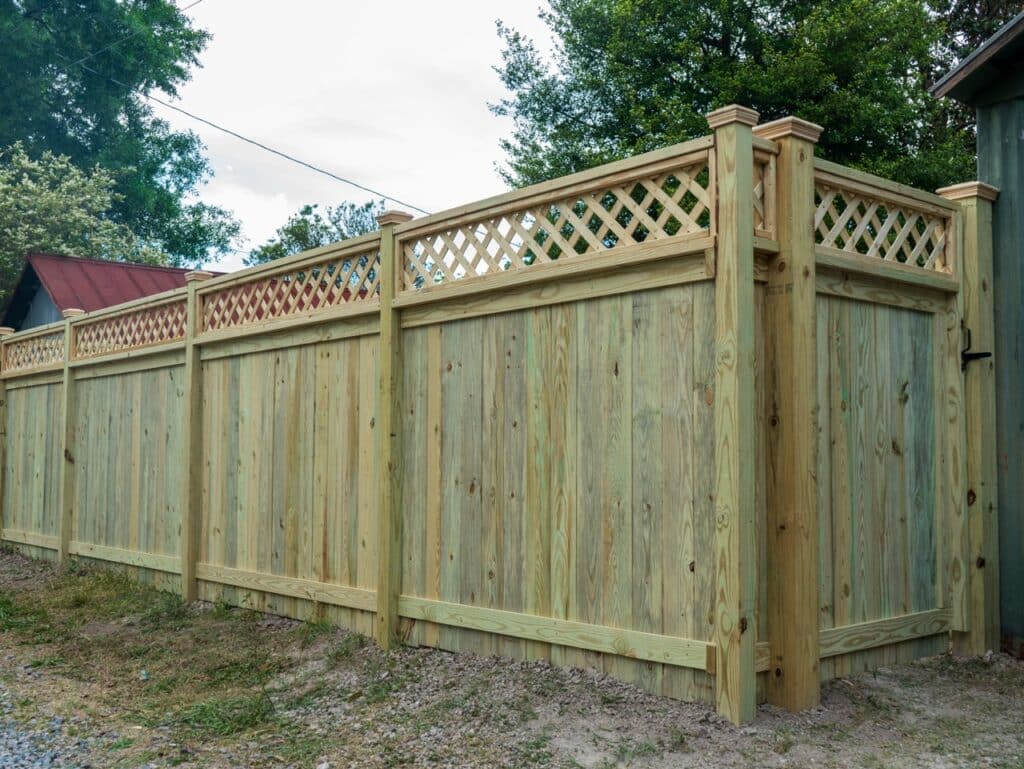
A lattice top adds a band of open pattern above solid boards. It keeps the lower part of the fence fully private and makes a tall fence feel lighter from inside. Cap and trim adds a flat cap board and a trim strip below it. That covers the board tops and gives the fence a finished edge. See the board and lattice fence we built for a Richmond home.
Tall Wood Privacy Fence Ideas
If 6 feet isn’t enough, a taller fence may be allowed in side and rear yards, depending on your locality. Taller fences need longer posts set deeper and closer attention to wind. Our post on tall wood fence ideas walks through the options, from back lot line height to lattice and trim.
Tell us about your yard and get a fast, free quote for the fence you want.
- Family owned since 2006
- Most installs take 1 to 2 days
- Financing from 0% APR for qualified buyers
or call (804) 737-4664
Vinyl Privacy Fence Ideas
Vinyl privacy fences use interlocking pickets or solid panels, so there are no board gaps to open up over time. Upkeep is mostly a wash with a garden hose and a mild cleaner, as VEKA’s vinyl fence care guide describes. There’s no staining or sealing. That makes vinyl fence installation a good fit for families who want privacy without the yearly chores.

Vinyl Privacy Fence Colors and Two-Tone Looks
White is the classic choice. Still, tan and other earth tones blend into wooded lots and tend to hide dirt better. A two-tone fence pairs one color for posts and rails with another for the panels. For one family in Chesterfield, we built this vinyl fence beneath tall trees.
Vinyl Toppers and Accents
For example, toppers such as lattice, spindles or scallops add a little height and soften a long run. They’re a good way to finish a fence where a solid 6 foot panel feels heavy. See these vinyl fence topper ideas for examples.
Build a Privacy Fence for Virginia Wind
A solid privacy fence catches wind like a sail, and Virginia storms can be rough. In the June 2012 derecho, the National Weather Service recorded gusts of 60 to 80 mph in central Virginia. So the parts you can’t see matter most: post size, post depth, footings and post spacing.
Shadowbox boards and lattice tops let some air through, which eases the load on the posts. Vinyl panels need posts and reinforcement matched to their height. So ask how a vinyl fence is braced before you sign. Our post on how much wind a vinyl fence can withstand covers the details.
Semi-Privacy Fence Ideas and Partial Screens
Not every fence line needs full privacy. Semi-privacy styles, such as horizontal boards with small gaps, mark the line and break up the view. They also let light and air through. They work well along a side yard or where an HOA limits solid fences.
A short run of privacy fence can also hide a patio, hot tub, trash cans or HVAC units. For more ways to screen a tight lot, see these privacy ideas for small backyards.
How Tall Can a Privacy Fence Be in Virginia?
In most of Virginia, you don’t need a building permit for a fence. But local zoning still limits how tall it can be. The Virginia Uniform Statewide Building Code exempts fences of any height from a building permit. The exceptions are swimming pool barriers and fences required for pedestrian safety. Height limits come from local zoning, and they’re usually lower in front yards than in side and rear yards.
Local Height Limits Vary
For example, here’s how that looks in a few of the localities we serve:
- Chesterfield County: up to 7 feet in side and rear yards. Front and corner side yards top out at 4 feet, per the county’s fences, walls and screening rules.
- Henrico County: the Permit Center says fences up to 7 feet that aren’t pool barriers don’t need a permit.
- Spotsylvania County: residential fences can reach 10 feet, but front yards are capped at 4 feet, per the county FAQ.
Other localities, including the City of Richmond, Stafford County and Fauquier County, set their own limits. Our guide to privacy fence height in Virginia lists the limits for Richmond, Henrico, Chesterfield, Hanover and Stafford. So confirm with your zoning office before you plan a fence over 6 feet.
Corner Lots, HOAs and Property Lines
Corner lots have extra rules because a tall fence can block drivers’ view. On a Chesterfield corner lot, for example, no fence or wall can top 2 feet within 30 feet of the corner. HOAs often go further and control height, material, color and which side faces out, so read your covenants first.
Our guides on installing a fence in an HOA and Virginia property line fence rules cover both.
Pools Need a Permitted Barrier
A privacy fence that doubles as a pool barrier needs a building permit. It also has to meet barrier rules for height, openings and gates. Read our Virginia pool fence regulations before you plan one.
Privacy Fence Ideas for Sloped Yards
Slopes are where many privacy fences fall short. There are two ways to handle grade. Stepping sets each section level and drops it at the post, while racking tilts the rails to follow the slope. Stepped panels leave triangle-shaped gaps under each section. On a steep lot, those gaps can be big enough for a dog to slip through.
A stick-built wood fence avoids that problem. Because we build wood fences board by board on site, each board can run down to the ground line. So the fence follows the grade with no gaps under it. Rigid vinyl panels usually step instead. On steep ground, the openings under each panel need a plan before the fence goes in. For the process, see our guide to installing a fence on a slope. To compare materials, read about the best fence for a sloped yard.

How to Choose the Best Privacy Fence for Your Yard
The best privacy fence for your yard depends on what you’re blocking, how much upkeep you want, and what’s allowed. So before you pick from the privacy fence ideas above, start with these questions:
- What do you want to hide? A neighbor’s second-story window calls for height or a lattice top. A busy street calls for full coverage at eye level.
- How much upkeep will you do? Wood needs periodic cleaning and sealing. Vinyl mostly needs a wash.
- Is the ground level? On slopes, a stick-built wood fence follows the grade without gaps.
- Do you have dogs? A fence with no gaps under it keeps small dogs from squeezing out. See our guide to the best fence for dogs.
- Where do gates go? Plan gates as part of the fence for mowers, trash cans and trailers. These wood fence gate designs can help.
- What do your HOA and zoning allow? Check height, material and color rules before you choose.
Wood or Vinyl Privacy Fence Styles Compared
| Style | Privacy | Upkeep | Relative cost | Best for |
|---|---|---|---|---|
| Solid board wood (dog-ear, flat, concave) | Full when new; thin gaps can open as boards dry | Periodic cleaning and sealing | Lowest of the wood privacy styles | Full privacy on a tighter budget |
| Shadowbox wood | Full straight on, some view at a sharp angle | Periodic cleaning and sealing | Middle | Shared lot lines and windy spots |
| Board on board wood | Full at any angle | Periodic cleaning and sealing | Higher, since it uses more lumber | Close neighbors and busy streets |
| Horizontal wood | Full or semi, set by board spacing | Periodic cleaning and sealing | Middle to higher | Modern homes and small lots |
| Solid vinyl panel | Full, with no shrinkage gaps | Occasional wash | Higher upfront | Low upkeep |
| Lattice top (wood or vinyl) | Full below, filtered above | Same as the fence below it | Adds a little | Softening a tall fence |
Relative cost depends on height, footage and the site. A fast, free quote gives you a real number.
Still deciding between the two materials? Our vinyl vs wood fence guide compares lifespan, upkeep and gaps.
Some homeowners think about building the fence themselves. That can work on a short, level run. But digging post holes, setting posts plumb and fitting boards to the grade take time and tools. You’ll also need to contact Virginia 811 at least 3 working days before you dig. Our post on whether it’s cheaper to put up your own fence lays out the trade-offs.
What Drives Privacy Fence Cost?
Privacy fence cost depends on material, height, total footage, board style and site conditions. Vinyl and board on board wood usually cost more than a single-layer wood fence. Taller fences need more material and longer posts. Slopes, rocky soil, tree roots and old fence removal all add labor. Gates, built as part of the fence, add hardware and heavier posts.
For a closer look, see our breakdown of privacy fence cost. Financing through Wisetack starts at 0% APR for qualified buyers. A fast, free quote gives you a real number for your yard.
Privacy Fence Questions We Hear Most
What is the best privacy fence for full coverage?
Board on board gives the most privacy in wood, since overlapping boards leave no line of sight. In vinyl, a solid panel fence gives the same full coverage.
Do I need a permit for a privacy fence in Virginia?
Usually not a building permit, since the state building code exempts fences that aren’t pool barriers or pedestrian safety fences. But local zoning still sets height and placement rules, and many HOAs require approval, so check both before you build.
Which side of a privacy fence faces the neighbor?
Many homeowners face the finished side out toward neighbors and the street, and some HOAs require it. A shadowbox fence looks the same from both sides, so the question goes away.
Can a privacy fence cut down on noise?
A solid fence can soften some street and yard noise, but it isn’t a sound wall. Solid styles block more than shadowbox or lattice, and a planting bed along the fence helps a little more.
How long does a privacy fence installation take?
Most Good Neighbor Fence installs take 1 to 2 days. However, long runs, steep slopes and several gates can add time.
Get a Free Privacy Fence Quote
Good Neighbor Fence is family owned since 2006, with 400+ five-star Google reviews. We build wood and vinyl privacy fences across Central Virginia and Northern Virginia. Browse our fence projects for more privacy fence ideas, then request a fast, free quote. Call (804) 737-4664 in Central Virginia or (540) 506-4835 in Northern Virginia.
Up to 7 feet in side and rear yards, while front yards stop at 4 feet.
No building permit is needed when a fence is 7 feet or less and not a pool barrier.
Up to 8 feet in side and rear yards. Call (540) 506-4835.